


 Aug 14,2026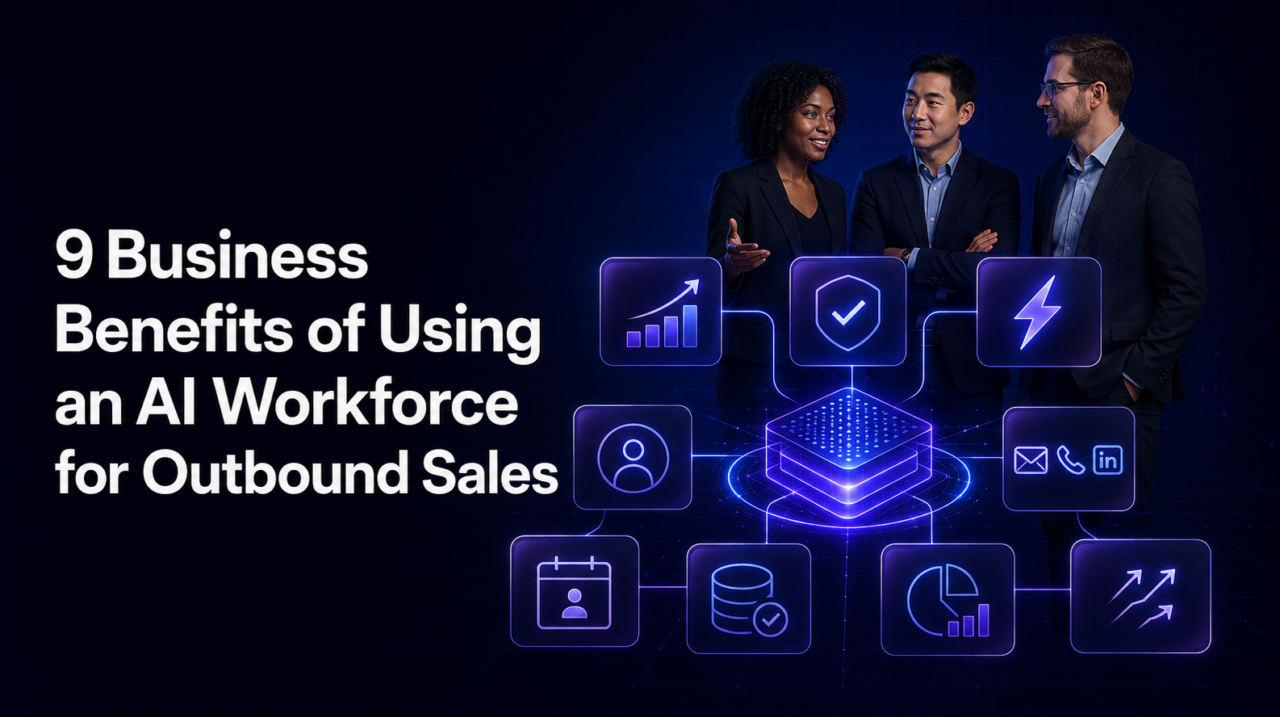
Outbound sales requires several responsibilities to operate as one process. Teams must identify suitable accounts, find decision-makers, verify contact information, prepare relevant messages, coordinate outreach, manage follow-ups, qualify responses, schedule meetings, and update CRM records.
Many companies use separate tools for these activities. Sales representatives still transfer information, monitor campaigns, review replies, manage follow-ups, and determine what should happen next. This limits the value created by individual automation tools.
An AI workforce provides a different operating model. It distributes outbound responsibilities across specialist AI employees and coordinates their work through an orchestrator. Research supports personalization, verified data moves into outreach, prospect responses determine the next action, and activity records are maintained throughout the process.
The business benefits come from coordinating the complete workflow, not simply automating more tasks or sending more messages.
What Is an AI Workforce for Outbound Sales?
An AI workforce for outbound sales is a coordinated group of specialist AI employees assigned to different stages of outbound execution.
One AI employee may research target companies, while another verifies contact information. Other employees may manage email, LinkedIn, and voice outreach, qualify responses, schedule meetings, and maintain CRM records.
An orchestrator coordinates these roles. It assigns tasks, transfers prospect context, manages dependencies, applies campaign rules, and determines when work should move from one employee to another.
This differs from using several disconnected sales tools. In a connected AI workforce, each activity contributes to the same process and uses shared information.
Businesses comparing these operating models can examine the difference between an AI agent and an AI workforce.
1. Greater Outbound Capacity
Prospect research, enrichment, personalization, follow-up, scheduling, and CRM administration consume a substantial amount of sales representatives’ time.
An AI workforce can complete these structured responsibilities across a larger number of prospects. This allows the business to expand outbound activity without placing the same amount of additional administrative work on founders and sales representatives.
Greater capacity should not be measured by message volume alone. Reaching more unsuitable prospects does not improve sales performance. The workforce must apply approved targeting criteria and prioritize accounts with a credible connection to the company’s offering.
The expected result is the ability to manage more suitable prospects while maintaining the quality of research, personalization, and follow-up.
Teams seeking to increase outbound sales capacity without increasing headcount should examine the complete workflow and coordinate prospecting responsibilities without transferring more administrative work to sales representatives.
2. More Consistent Outbound Execution
Manual outbound sales depends on representatives remembering every task, following the correct sequence, and updating each system at the appropriate time.
This becomes difficult as prospect numbers increase. Follow-ups may be missed, interested responses may not receive timely attention, and prospect information may remain in individual inboxes or spreadsheets.
An AI workforce applies approved rules across the process. These rules may cover:
- Ideal customer profile criteria
- Prospect research requirements
- Data verification
- Personalization standards
- Outreach channels
- Follow-up timing
- Qualification criteria
- Approval requirements
- Escalation conditions
- CRM updates
Consistent execution reduces variations caused by manual coordination. It gives the business a repeatable process that can be monitored and improved.
Consistency does not mean sending identical messages to every prospect. It means applying the same operating standards while adapting communication to each buyer’s role, company, and business context.
3. More Relevant Personalization at Scale
Personalization often declines when a sales team increases outreach volume. Representatives may rely on templates containing only a name, job title, or company field.
An AI workforce can connect prospect research, enrichment, and message preparation. This gives the employee responsible for outreach access to relevant account and buyer information before creating a message.
Personalization may reflect:
- The buyer’s role and responsibilities
- The company’s industry and size
- A relevant business requirement
- An approved account signal
- The company’s value proposition
- The campaign objective
- Previous prospect interactions
The message can explain why the offer is relevant instead of presenting a generic proposition to every contact.
An AI workforce can support outbound sales personalization at scale without requiring representatives to research and write every message individually.
The business value comes from improving the relevance of outreach while preserving the capacity to reach more suitable prospects.
4. Faster Response and Follow-Up Management
Many outbound prospects do not respond to the first message. Others express interest but require more information, request contact at a later date, or raise a question that needs human attention.
A coordinated AI workforce can monitor these responses and assign the appropriate next action. It may continue an approved follow-up sequence, pause communication, provide relevant information, move a qualified prospect to scheduling, or transfer a complex conversation to a sales representative.
This reduces delays between prospect activity and the company’s response.
Timely execution matters throughout the workflow. A suitable prospect may lose interest when a response remains unanswered. A booked meeting may still receive irrelevant follow-ups when campaign systems are not connected. A contact who requests communication at a later date may be contacted too early.
Coordinated response handling helps the business maintain a more controlled and responsive outbound process.
5. Better Coordination Across Outreach Channels
Email, LinkedIn, and voice outreach are often managed through separate platforms. Without shared context, the same prospect may receive repetitive messages or continue receiving promotional communication after responding through another channel.
An AI workforce can coordinate these channels through shared prospect information and campaign rules.
For example:
- A LinkedIn response can pause the active email sequence.
- A phone conversation can update the prospect’s qualification status.
- A request to reconnect later can pause activity across all channels.
- A booked meeting can stop unnecessary follow-ups.
- An opt-out can prevent further campaign communication.
The objective is not to contact every prospect through every channel. The workforce should select suitable channels, coordinate timing, and adjust the sequence when the prospect’s status changes.
Businesses can automate prospecting, outreach, and follow-ups as one process instead of managing separate campaigns.
6. More Reliable CRM Records
CRM records are valuable only when they contain current and complete information. Manual updates are often postponed when representatives are focused on sales conversations and closing activities.
An AI workforce can record relevant information as work progresses. Depending on the company’s systems and configuration, this may include:
- Account and contact details
- Outreach activity
- Prospect responses
- Qualification information
- Current prospect status
- Meeting details
- Assigned representative
- Agreed next action
Reliable CRM records give sales teams a clearer view of each prospect and the wider outbound process.
They reduce the risk of information remaining inside an inbox, spreadsheet, or individual representative’s notes. They help prevent duplicate outreach and provide useful context when responsibility transfers to another team member.
7. Greater Visibility Into Outbound Performance
When outbound activities are distributed across separate systems, sales leaders may struggle to understand what is happening across the process.
They may see how many emails were sent without knowing whether the target accounts were suitable, whether responses were qualified correctly, or whether interested prospects received timely follow-up.
A coordinated AI workforce can provide visibility across account selection, data quality, outreach activity, response classification, qualification, meeting scheduling, and CRM completion.
This makes it easier to locate performance problems.
If a campaign underperforms, the team can assess whether the issue comes from:
- Target account selection
- Contact data quality
- Message relevance
- Channel selection
- Follow-up execution
- Response handling
- Qualification criteria
- Meeting scheduling
- CRM administration
The business can improve the stage where the problem occurs instead of changing the entire outbound strategy without clear evidence.
8. More Time for High-Value Sales Work
Sales representatives create the greatest value when they are speaking with suitable prospects, conducting discovery, demonstrating the product, handling objections, negotiating terms, and building customer relationships.
Yet many representatives spend a considerable part of their time researching accounts, preparing contact lists, monitoring sequences, coordinating schedules, and updating records.
An AI workforce can take responsibility for much of this structured execution. Human representatives can focus on activities that require judgment, experience, product knowledge, and personal interaction.
This does not remove people from the sales process. It changes where their time is allocated.
The workforce can manage routine responsibilities, while human teams retain control over strategy, campaign approval, strategic accounts, complex conversations, pricing, and commercial decisions.
9. A More Scalable Outbound Operating Model
Adding more tools may increase the number of activities a business can automate, but it can create more systems for the sales team to manage.
An AI workforce provides a scalable operating model by connecting roles, information, and decisions across the outbound process.
As prospect volume grows, the business can expand activity within an established structure. Targeting criteria, messaging standards, qualification rules, approval requirements, and CRM processes remain defined.
This is particularly relevant for startups and growing businesses that need to increase sales activity without expanding operational complexity at the same rate.
The company can build on a connected process instead of adding another isolated tool whenever a new requirement appears.
How Autonoms AI Executes Outbound Sales
Autonoms AI is an AI workforce for outbound execution.
It provides specialist AI employees across prospect research, lead enrichment, email outreach, LinkedIn outreach, voice outreach, qualification, meeting scheduling, and CRM hygiene.
An orchestrator coordinates tasks, information, and handoffs across the workforce. Research supports personalization, prospect responses determine the next action, qualified prospects move to scheduling, and relevant activity is recorded in the CRM.
Human-in-the-loop oversight gives businesses visibility and control over execution. Companies can define which activities may be completed automatically, which require approval, and which situations should be transferred to a human representative.
This connected structure helps businesses move beyond isolated sales automation and manage outbound responsibilities through one coordinated workforce.
Build Outbound Capacity Through Coordinated Execution
The main business value of an AI workforce comes from coordinating the responsibilities required to create qualified sales conversations.
It can help companies manage more suitable prospects, maintain consistent follow-up, personalize outreach, coordinate communication channels, keep CRM records current, and give sales representatives more time for high-value work.
Autonoms AI provides the specialist AI employees and coordination required to execute outbound sales as one connected process.
Generate more qualified sales conversations and booked meetings with an AI workforce built for outbound execution. Get started with Autonoms AI.