


 Jul 17,2026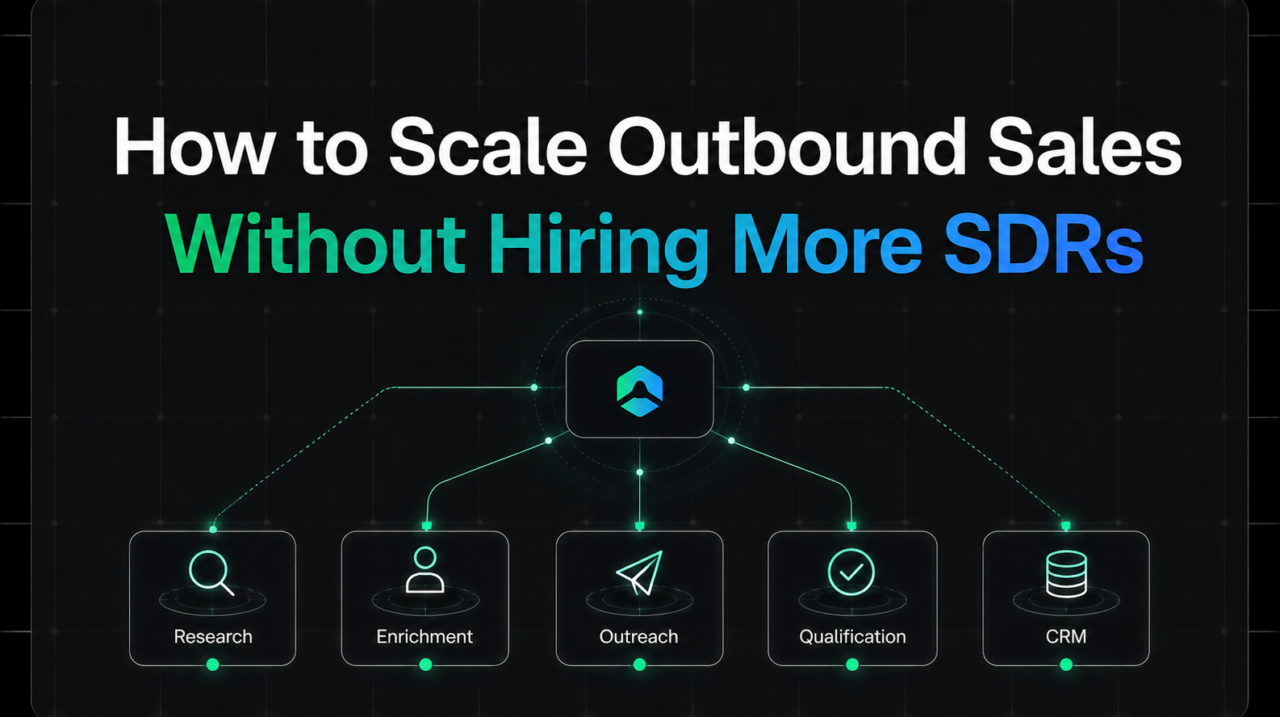
Growing an outbound sales execution usually creates a familiar challenge. The business wants to reach more prospects, generate more qualified conversations and build a larger pipeline, but the existing sales development team has limited capacity.
The traditional solution is to hire more sales development representatives. However, every additional SDR introduces recruitment, onboarding, compensation, training, management and technology costs. It can also take several months before a new representative becomes fully productive.
Hiring remains important when a business needs more people to build relationships, lead strategic conversations and close complex deals. But adding headcount is not the only way to increase outbound capacity.
Companies can scale outbound sales by improving their processes, focusing on the right prospects and using AI to manage repetitive work across research, outreach, follow-ups, qualification, scheduling and CRM administration.
What Does It Mean to Scale Outbound Sales?
Scaling outbound sales means increasing the number of suitable prospects your company can identify, contact, qualify and convert without costs and operational complexity increasing at the same rate.
It is not simply about sending more emails or making more calls.
A scalable outbound process should help a business:
- Reach more qualified prospects
- Maintain relevant and personalised communication
- Follow up consistently
- Respond to interested leads quickly
- Book more suitable sales meetings
- Keep CRM records accurate
- Measure performance across the entire workflow
- Increase output without overwhelming the sales team
If outbound activity increases but message quality, response time or lead qualification declines, the process is not scaling effectively. It is only becoming busier.
Why Adding More SDRs Is Not Always the Best First Step
More SDRs can increase activity, but additional headcount does not automatically solve weaknesses in the outbound process.
If targeting is poor, adding more representatives may only increase the number of unsuitable prospects contacted. If messaging is generic, a larger team may send more ineffective messages. If workflows are fragmented, additional staff may create even more administrative work.
Before hiring, sales leaders should determine whether the real problem is insufficient headcount or an inefficient sales system.
Recruitment takes time
Finding suitable SDRs can involve advertising, interviewing, assessment and negotiation. The company must then wait for the new employees to begin work.
If a business needs to increase sales activity quickly, recruitment may not provide an immediate solution.
New representatives require onboarding
A new SDR must learn the product, ideal customer profile, messaging, tools, CRM process and qualification criteria.
They may also need time to understand the industry and become comfortable handling prospect objections.
During this period, managers and experienced representatives must spend time supporting the new employee.
Sales headcount introduces additional costs
The cost of hiring an SDR extends beyond salary. It may also include:
- Recruitment
- Benefits and taxes
- Training
- Management
- Sales software
- Data providers
- Calling tools
- Email infrastructure
- Equipment
- Employee turnover
These expenses can make it difficult for smaller companies to expand their outbound teams rapidly.
Representatives spend time on non-selling work
Hiring more representatives does not automatically ensure that more time will be spent speaking with prospects.
SDRs often complete activities such as:
- Searching for accounts
- Finding contact details
- Reviewing websites and LinkedIn profiles
- Preparing messages
- Organising contact lists
- Sending follow-ups
- Scheduling meetings
- Writing call notes
- Updating CRM records
- Preparing activity reports
If the underlying process remains manual, every new SDR may inherit the same inefficiencies.
Seven Ways to Scale Outbound Sales Without Hiring More SDRs
1. Define a Clear Ideal Customer Profile
A broad target market makes outbound sales harder to scale.
When sales representatives do not know exactly which companies to pursue, they spend more time evaluating unsuitable accounts. Messages also become more generic because they must appeal to too many types of businesses.
A clear ideal customer profile helps the sales team focus on organisations with the strongest potential need for the product.
Your ideal customer profile may include:
- Industry
- Company size
- Revenue range
- Location
- Business model
- Growth stage
- Technology used
- Relevant operational challenges
- Recent hiring or expansion
- Buying or intent signals
You should also define the people involved in the buying process. These may include the economic buyer, operational user, technical evaluator and internal champion.
For example, a founder may care about increasing sales capacity without rapidly expanding headcount. A RevOps leader may care more about workflow coordination, CRM accuracy and performance visibility.
Clear targeting reduces wasted effort and creates a stronger foundation for personalised outreach.
2. Standardise Your Outbound Sales Process
A sales process becomes difficult to scale when every representative uses a different approach.
Create a documented workflow that explains how prospects move from initial identification to a qualified meeting.
The workflow should define:
- How target accounts are selected
- What information must be collected
- How contacts are verified
- How leads are prioritised
- Which channels should be used
- When follow-ups should be sent
- How responses should be classified
- What makes a lead qualified
- When a lead should be transferred
- Which CRM fields must be updated
Standardisation does not mean treating every prospect identically. It creates a consistent operating structure within which personalisation can happen.
It also makes it easier to identify which steps can be automated safely.
3. Automate Prospect Research and Data Enrichment
Manual prospect research can consume a significant amount of an SDR’s time.
Before contacting a prospect, a representative may need to determine:
- Whether the company matches the ideal customer profile
- Who the relevant decision-maker is
- What the company does
- How large the organisation is
- Which market it serves
- Whether there are relevant buying signals
- How the prospect can be contacted
AI can collect, organise and summarise relevant information from approved data sources. It can also enrich existing CRM records with additional company and contact information.
This reduces the time sales representatives spend switching between platforms and searching for basic facts.
Research automation should not be used to collect as much data as possible without a clear purpose. The system should focus on information that improves targeting, qualification or personalisation.
Businesses must also respect privacy requirements, platform rules and applicable data-protection laws.
4. Use AI to Score and Prioritise Prospects
Long prospect lists can create the appearance of a large opportunity while hiding a targeting problem.
Instead of asking SDRs to treat every lead equally, use a scoring system to identify the prospects most likely to be relevant.
Lead scores may consider:
- Ideal customer profile fit
- Job title and decision-making authority
- Company size
- Industry
- Location
- Technology used
- Recent company developments
- Engagement with previous outreach
- Indications of an active need
High-scoring prospects can receive more immediate or personalised attention. Lower-scoring prospects may enter a nurturing process or be removed from the active campaign.
AI can analyse these factors and update scores as new information becomes available.
Sales leaders should still understand how the score is produced. A transparent scoring model makes it easier to correct poor assumptions and adjust priorities.
5. Automate Personalised Outreach and Follow-Ups
Personalisation and scale are often treated as opposing goals.
Manually writing every message creates strong personalisation but limits capacity. Sending one generic template to thousands of people increases capacity but often reduces relevance.
AI can help close this gap by combining approved messaging with prospect-specific information.
It may personalise communication based on:
- The recipient’s role
- Company characteristics
- Industry challenges
- Public business developments
- Relevant products or services
- Previous interactions
- Likely operational priorities
The objective is not to produce messages that appear artificially personal. Each message should present a clear and credible reason for contacting the prospect.
AI can also manage follow-ups according to the prospect’s behaviour. A person who requested information should not receive the same follow-up as someone who has not responded.
A structured follow-up system can recognise whether the prospect:
- Responded positively
- Requested more information
- Asked to be contacted later
- Raised an objection
- Booked a meeting
- Missed a scheduled meeting
- Asked not to receive further messages
This allows the sales team to maintain consistent communication without manually tracking every interaction.
6. Automate Lead Qualification and Meeting Scheduling
Not every positive response represents a qualified sales opportunity.
Sales representatives may spend time arranging meetings with prospects who do not match the company’s target market, lack an active need or are not involved in the decision.
AI can support initial qualification by collecting information such as:
- The prospect’s current challenge
- The solution currently being used
- The importance of solving the problem
- The organisation’s expected timeline
- The people involved in the decision
- Whether the company meets the qualification criteria
When a prospect is qualified, the system can provide available meeting times, schedule the conversation, send a calendar invitation and issue reminders.
The sales representative then receives the meeting together with the relevant account information, conversation history and qualification notes.
This allows the human sales team to concentrate on suitable conversations rather than handling every administrative step leading to a meeting.
7. Automate CRM Updates and Sales Administration
An outbound process cannot scale reliably when its CRM depends entirely on manual data entry.
Representatives may forget to record calls, change lead statuses or schedule follow-ups. The CRM then provides an incomplete view of the pipeline.
AI can record activities and update approved fields following an email, call, response or meeting.
Updates may include:
- Contact information
- Account details
- Last activity
- Lead status
- Conversation summary
- Qualification information
- Scheduled meeting
- Next action
- Follow-up date
- Reason for disqualification
Businesses should establish clear permissions for CRM automation. Routine updates may happen automatically, while significant changes may require approval.
Accurate CRM data gives managers stronger visibility without requiring representatives to spend excessive time on administration.
Sales Tools vs. a Coordinated AI Workforce
Businesses often attempt to scale outbound sales by purchasing separate tools for prospecting, data enrichment, email sequencing, LinkedIn outreach, calling, scheduling and CRM management.
Each tool may solve a particular problem, but the sales team must still connect the workflow.
A representative may research a company on one platform, export the information to another, create a message elsewhere and manually update the CRM after outreach. This creates additional work and increases the risk of inconsistent data.
A coordinated AI workforce provides a different model.
Specialist AI employees can be assigned to different stages of the outbound process, including:
- Prospect research
- Data enrichment
- Lead scoring
- Email outreach
- LinkedIn outreach
- Cold calling
- Lead qualification
- Meeting scheduling
- CRM management
An orchestrator coordinates the work and determines how information moves from one AI employee to another.
For example, the research AI employee can identify a suitable prospect and transfer the account information to the enrichment AI employee. Once the data is complete, the scoring AI employee can evaluate the opportunity before the outreach AI employee prepares communication.
This creates one connected outbound operation instead of a collection of disconnected automations.
Read The Complete Guide to AI-Powered Outbound Sales to understand how AI can support the complete sales workflow.
What Should Remain Human-Led?
Scaling outbound sales with AI does not require removing people from the process.
Human sales professionals remain important for activities that require judgment, trust and complex communication.
These may include:
- Defining the sales strategy
- Choosing target markets
- Approving important campaigns
- Conducting complex discovery calls
- Understanding unusual customer requirements
- Building relationships
- Handling sensitive objections
- Negotiating terms
- Closing deals
- Reviewing AI performance
The goal is to separate repetitive execution from work that benefits most from human experience.
AI can conduct research, organise data, manage follow-ups and coordinate schedules. Human representatives can use the time created to lead better sales conversations.
How to Know Whether Your Outbound Process Is Ready to Scale
Before increasing activity, review whether the current system has a reliable foundation.
Your outbound process may be ready to scale if:
- The ideal customer profile is clearly defined
- The sales team knows which decision-makers to contact
- Messaging is producing relevant responses
- Qualification criteria are documented
- Follow-up sequences are consistent
- Meetings are recorded and tracked
- The CRM contains accurate information
- Sales leaders can identify which activities produce opportunities
- Human approval points are clearly established
If these elements are missing, increasing volume may magnify existing problems.
Begin by correcting the process. Automation should support a strong workflow, not hide a weak one.
Metrics to Track When Scaling Outbound Sales
Measuring only the number of emails sent or calls completed can encourage activity without showing business value.
A scalable outbound system should track the movement from targeting to revenue opportunity.
Important metrics include:
- Qualified response rate :The percentage of contacted prospects who respond with relevant interest or a suitable business need.
- Meeting-booking rate:The percentage of contacted or responding prospects who schedule a meeting.
- Meeting attendance rate: The percentage of booked meetings that take place.
- Lead-to-opportunity conversion rate:The percentage of qualified leads that become active sales opportunities.
- Cost per qualified opportunity: The total cost of outbound execution divided by the number of qualified opportunities generated.
- Time to first response:How quickly interested prospects receive a reply or next step.
- Follow-up completion rate:The percentage of required follow-ups completed on schedule.
- CRM data accuracy:The completeness and accuracy of contact, account and activity records.
- Time saved: The amount of representative time no longer spent on repetitive research, scheduling and administration.
These measurements provide a more accurate view of whether outbound sales is scaling efficiently.
Common Mistakes to Avoid
- Increasing volume before improving targeting: Contacting more people will not solve an unclear ideal customer profile.
- Automating poor messaging: Automation makes it possible to distribute a message faster. It does not make an irrelevant message more effective.
- Using too many disconnected tools: Adding software without coordinating the workflow can increase complexity for the sales team.
- Removing human review entirely: AI-generated research and messages may contain errors. Businesses should maintain appropriate approval and escalation processes.
- Ignoring channel rules and regulations: Companies must respect email requirements, calling regulations, privacy laws and platform policies in the markets where they operate.
- Measuring activity instead of outcomes: A successful outbound programme should produce qualified conversations and opportunities, not simply large activity numbers.
How Autonoms AI Helps Businesses Scale Outbound Sales
Autonoms AI enables businesses to increase outbound execution capacity through a coordinated team of specialist AI employees.
The platform supports activities across the outbound sales process, including:
- Prospect research and enrichment
- Lead scoring and prioritisation
- Personalised email and LinkedIn outreach
- Cold calling
- Follow-up management
- Lead qualification
- Meeting scheduling
- CRM updates and hygiene
Instead of requiring sales teams to manage each activity through a separate tool, Autonoms AI uses an orchestrator to coordinate work across the AI workforce.
Human-in-the-loop oversight allows businesses to control important decisions, review sensitive actions and define when human approval is required.
Scale Execution, Not Just Headcount
Hiring more SDRs may be necessary as a company grows, but it should not be the only way to increase outbound capacity.
A scalable sales system combines clear targeting, standardised workflows, coordinated AI execution and human oversight.
By using AI to manage repetitive activities, businesses can reach more suitable prospects, respond more quickly and keep sales records accurate. Human salespeople can then concentrate on the conversations and decisions that require their expertise.
Autonoms AI helps organisations build a coordinated outbound operation with specialist AI employees working across prospect research, outreach, qualification, scheduling and CRM management.
Ready to increase outbound execution without increasing headcount at the same rate?
Visit https://autonoms.ai/ to learn how an AI workforce can support your outbound sales process.