


 Oct 16,2026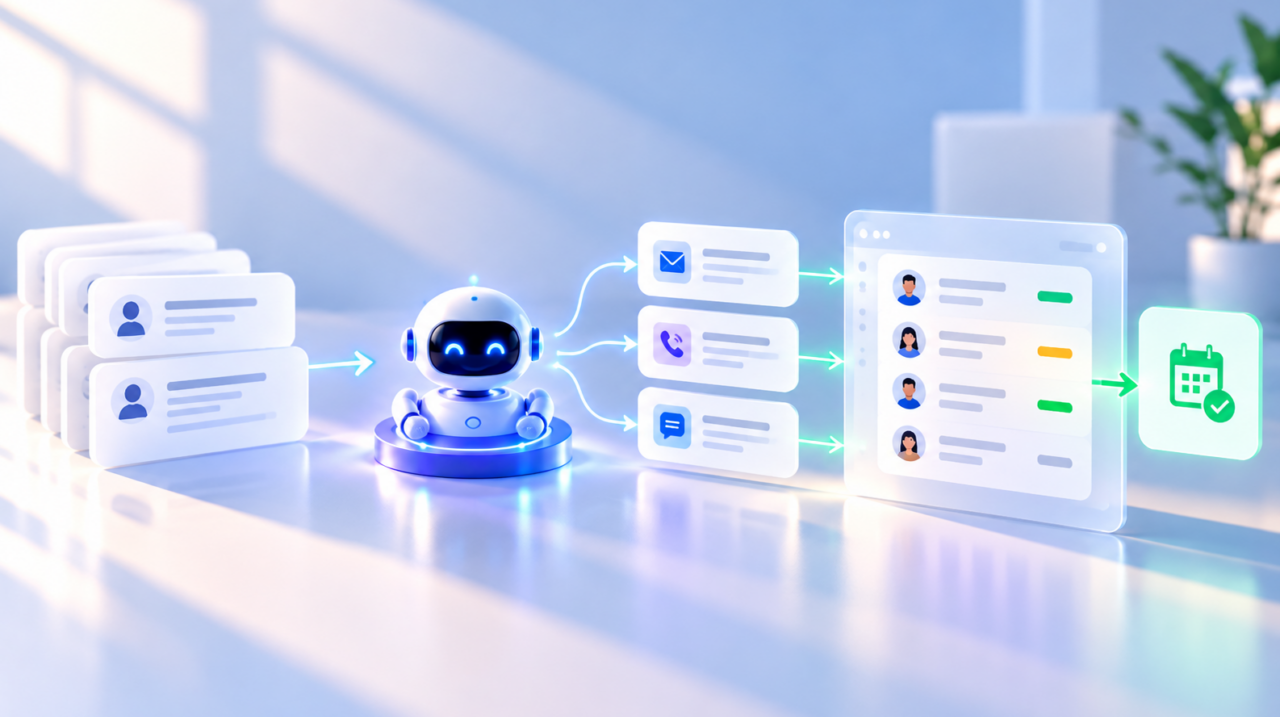
Revenue growth depends on a company’s ability to consistently identify potential customers, generate qualified opportunities, and convert those opportunities into business. However, many sales organizations still rely heavily on manual processes to execute activities that support these objectives.
Prospect research, contact enrichment, personalized outreach, follow-ups, lead qualification, and customer relationship management (CRM) updates require considerable time and operational resources. As outbound activity increases, businesses may need to expand their sales teams to manage the additional workload.
According to Salesforce’s State of Sales research, sales representatives spend only 28% of their working week actively selling. The remaining time is allocated to other responsibilities, including prospect research, administrative work, planning, and data entry.
For business leaders, this raises an important question about how to expand sales operations without allowing execution costs to increase at the same rate.
An AI workforce offers a different approach by using specialized AI employees to manage and coordinate repetitive outbound sales activities. This allows businesses to increase execution capacity while enabling human sales professionals to focus on customer relationships, complex negotiations, and revenue-generating conversations.
Why Manual Sales Tasks Limit Revenue Growth and Operational Efficiency
Outbound sales requires consistent execution across prospect identification, outreach, follow-ups, qualification, and pipeline management. Each activity contributes to revenue generation, but performing these responsibilities manually can limit how much work a sales organization can manage.
As businesses expand into new markets or target additional customer segments, the volume of prospect information, communication, and administrative work increases.
For example, a company planning to double its outbound prospecting activity may need additional employees to research accounts, prepare outreach messages, manage responses, and maintain accurate CRM records.
This creates a challenge for organizations seeking to increase sales capacity while controlling operating expenses.
Manual execution can also affect pipeline development. Delayed follow-ups, inconsistent prospect information, and incomplete activity records can reduce the effectiveness of outbound campaigns and make performance more difficult to evaluate.
The financial implications extend beyond employee salaries. Businesses must also consider recruitment, onboarding, supervision, training, and the management resources required to support larger sales teams.
Although these activities remain important, requiring skilled sales professionals to perform every task manually can limit their availability for higher-value commercial responsibilities.
Organizations seeking more efficient growth must therefore evaluate how routine outbound activities can be completed without expanding human involvement at every stage.
How an AI Workforce Changes Outbound Sales Execution
An AI workforce consists of specialized AI employees that coordinate their activities to complete defined business responsibilities.
In outbound sales, AI employees can handle prospect research, contact enrichment, personalized outreach, lead qualification, follow-ups, meeting coordination, and CRM administration.
An orchestrator coordinates these employees so that information and responsibilities move between different stages of the sales process.
For example, a research AI employee can identify companies that match the organization’s ideal customer profile. An enrichment employee can gather relevant contact information, while an outreach employee uses that information to execute approved communication campaigns.
Responses can then inform qualification decisions, follow-up activities, and meeting coordination.
Unlike disconnected automation tools, an AI workforce is designed to manage these activities as part of a coordinated operational process.
The distinction between traditional AI sales automation and an AI workforce is particularly relevant for organizations seeking to improve sales execution across multiple functions rather than automate isolated tasks.
Human sales professionals remain responsible for activities requiring relationship management, commercial judgment, negotiation, and strategic decision-making.
The objective is to establish an operating model in which AI employees manage repeatable execution while human teams concentrate on responsibilities that require their expertise.
The Business Value of Reducing Manual Sales Tasks With an AI Workforce
Reducing manual sales responsibilities can create business value when improvements in execution translate into greater productivity, more efficient resource allocation, and stronger commercial performance.
For organizations evaluating AI investments, the relevant consideration is how coordinated execution can support business objectives without introducing unnecessary operating complexity.
1. Lower Sales Operating Costs
Sales operating costs extend beyond the compensation paid to sales representatives. Businesses must also account for recruitment, onboarding, employee training, software subscriptions, supervision, and the resources needed to manage daily sales operations.
When outbound processes rely heavily on manual execution, increasing activity can require additional personnel and supporting infrastructure.
An AI workforce can reduce dependence on manual effort by taking responsibility for repeatable activities such as prospect research, outreach preparation, follow-ups, and CRM administration.
For example, a company expanding its outbound campaigns may use AI employees to manage additional prospecting activity instead of assigning every new administrative responsibility to its existing sales team.
This can help control the rate at which operating expenses increase as outbound activity grows.
However, the financial benefit depends on the total cost of operating the AI workforce, including implementation, integrations, monitoring, and human oversight.
Organizations should evaluate whether the resulting productivity improvements or avoided expenses justify those costs rather than assuming that automation automatically reduces spending.
2. Increased Outbound Capacity Without Proportional Headcount Growth
Expanding outbound sales traditionally involves increasing the number of representatives responsible for identifying prospects, conducting outreach, and managing follow-ups.
This approach can become expensive as organizations enter new markets or increase their prospecting targets.
An AI workforce allows businesses to increase the volume of routine outbound activities without assigning every additional task to human employees.
For example, a business entering a new geographical market may need to research companies, identify relevant decision-makers, prepare localized outreach, and maintain ongoing communication.
Specialized AI employees can support these responsibilities through coordinated execution, allowing the existing sales team to manage a larger prospecting operation.
The commercial advantage is the potential to increase operational capacity without expanding headcount at the same rate.
However, increased activity should not be confused with increased revenue. Businesses must also evaluate prospect quality, response rates, qualified opportunities, and the effectiveness of human sales conversations.
3. More Consistent Sales Pipeline Development
A reliable outbound sales pipeline depends on the consistent identification, engagement, and qualification of potential customers.
When these activities are performed manually, execution can vary according to employee availability, competing responsibilities, and workload.
Prospects may receive delayed follow-ups, qualification information may remain incomplete, and potentially valuable opportunities may not receive sufficient attention.
An AI workforce can improve execution consistency by coordinating prospect research, outreach, follow-up activities, and qualification according to defined business requirements.
For example, when a prospect responds to an outreach message, the relevant information can move into qualification and meeting coordination without requiring a representative to manually manage every transition.
Coordinated prospecting, outreach, and follow-up processes can help businesses maintain continuity across outbound activities.
This supports more consistent pipeline development, although the quality of opportunities still depends on accurate targeting, effective communication, and market demand.
4. Improved Sales Team Productivity
Sales productivity should be evaluated by how effectively employee time contributes to business outcomes rather than simply how many activities representatives complete.
When sales professionals spend considerable time researching accounts, updating records, and tracking follow-ups, they have fewer opportunities to engage prospective customers directly.
An AI workforce can reduce these administrative responsibilities by coordinating routine activities and preparing relevant information for human teams.
For example, sales representatives may receive prospect records that already contain company information, engagement history, and initial qualification details.
This can reduce preparation time and allow representatives to concentrate on understanding customer requirements, conducting product discussions, and advancing suitable opportunities.
The resulting productivity benefit depends on how organizations use the recovered employee capacity.
If representatives can engage more qualified prospects or manage additional opportunities without increasing their workload, the business may achieve greater output from its existing sales resources.
5. Better Visibility Into Outbound Sales Performance
Business leaders need reliable information to evaluate outbound sales performance and make decisions about staffing, market expansion, and resource allocation.
When sales activities are recorded inconsistently across disconnected systems, organizations may struggle to understand campaign performance or identify problems affecting pipeline development.
An AI workforce can support more consistent activity records by coordinating execution and updating CRM information as prospects move through different stages.
For example, prospect engagement, qualification outcomes, meeting activity, and follow-up status can be recorded as part of the coordinated workflow.
This can improve the information available for evaluating outbound performance.
However, reliable reporting depends on accurate data, appropriate system integrations, and clear definitions of sales performance indicators.
For business leaders, better visibility supports more informed decisions about which campaigns, customer segments, and sales activities warrant continued investment.
How Autonoms AI Supports Scalable Outbound Sales Execution
Autonoms AI is an AI workforce designed to execute outbound sales responsibilities through specialized AI employees working together.
It brings activities such as prospect research, data enrichment, lead prioritization, personalized email and LinkedIn outreach, voice outreach, follow-ups, qualification, meeting scheduling, and CRM maintenance into a coordinated execution process.
Rather than requiring businesses to manage each activity through a separate tool or assign every responsibility to a human representative, Autonoms AI uses an orchestrator to coordinate how AI employees work together.
For example, when a research employee identifies a suitable account, relevant information can move to enrichment and outreach. Prospect responses can then inform qualification, follow-up decisions, meeting coordination, and CRM updates.
This connected approach helps reduce the administrative effort associated with managing multiple stages of outbound execution.
Autonoms AI also incorporates human-in-the-loop oversight, allowing organizations to establish approval requirements and retain control over sensitive actions.
For business leaders, its value lies in the ability to delegate repeatable outbound responsibilities to an AI workforce while keeping human sales teams focused on strategy, relationship development, and commercial decisions.
Measuring the Business Impact of an AI Workforce
Investing in an AI workforce should be evaluated against measurable operational and commercial outcomes.
Although automated execution can increase activity and reduce manual work, these improvements do not automatically translate into financial returns.
Organizations need to establish performance measures before implementation and compare them with results achieved after introducing the AI workforce.
Relevant indicators include sales operating costs, employee hours spent on repetitive activities, outbound prospecting capacity, qualified meetings, pipeline contribution, and the cost of acquiring sales opportunities.
For example, a business may spend 60 employee hours each week on prospect research and administrative responsibilities.
If an AI workforce reduces that requirement to 25 hours, the organization recovers 35 hours of employee capacity per week.
These figures are hypothetical and do not represent measured Autonoms AI performance. Actual improvements depend on data quality, workflow complexity, system integrations, and oversight requirements.
The organization must then determine whether the recovered capacity produces measurable value through additional prospect conversations, improved sales output, lower expenses, or avoided hiring requirements.
A basic return-on-investment calculation is:
ROI (%) = [(Financial Benefits − Total Investment Costs) ÷ Total Investment Costs] × 100
For example, if a company spends $50,000 implementing and operating an AI workforce over one year and generates $75,000 in verified financial benefits during the same period, its first-year ROI would be 50%.
These benefits must be measured carefully to avoid counting time savings as direct financial savings without evidence of additional output or avoided costs.
An accurate assessment of AI workforce return on investment should account for implementation expenses, ongoing operations, employee oversight, and actual commercial results.
What Business Leaders Should Consider Before Adopting an AI Workforce
Implementing an AI workforce requires clear business objectives, defined operational processes, and appropriate governance.
Business leaders should begin by identifying the responsibilities that consume significant employee time and determining whether delegating those activities to AI employees could improve operational performance.
Organizations must also establish accurate customer targeting criteria, approved outreach guidelines, qualification standards, and escalation requirements.
These foundations are important because poor prospect information and unclear business rules can lead to unsuitable outreach, inconsistent decisions, and unnecessary operational risks.
Technical readiness is another consideration. Businesses need to evaluate how the AI workforce will access relevant information, interact with existing CRM systems, and maintain accurate records.
Human oversight must also be defined before implementation. Sensitive communication, complex customer requirements, commercial negotiations, and decisions involving business risk may require employee review or direct involvement.
Finally, organizations should establish performance baselines and ongoing monitoring procedures to determine whether the AI workforce is producing the expected improvements.
A structured implementation approach helps businesses connect AI workforce adoption with broader commercial priorities rather than treating automation as a standalone technology investment.
Conclusion
Manual sales execution can limit an organization’s ability to expand outbound operations efficiently. As prospecting activity increases, businesses may face growing administrative workloads, additional staffing requirements, and higher operating expenses.
An AI workforce offers an alternative operating model by coordinating repeatable sales activities through specialized AI employees.
This approach can help organizations increase outbound capacity, improve execution consistency, and allow sales professionals to focus on higher-value commercial responsibilities.
Autonoms AI brings these responsibilities together in a coordinated AI workforce, supporting outbound execution while maintaining human oversight of important sales decisions.
For business leaders, the value of an AI workforce is ultimately determined by its contribution to measurable operational efficiency, qualified pipeline development, and sustainable revenue growth.