


 Aug 14,2026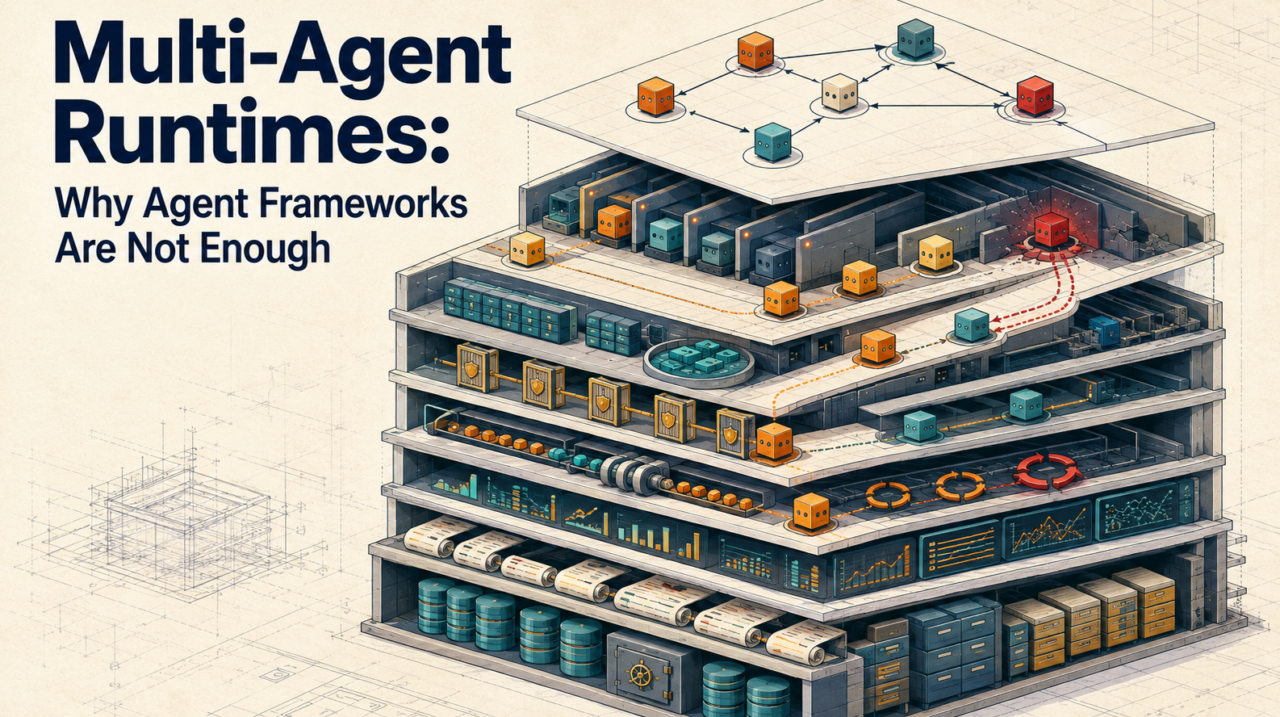
Most conversations about AI agents centre on prompts, orchestration workflows, and framework capabilities. However, moving from an agent prototype to a reliable production system introduces a different set of challenges.
Production teams need infrastructure that can coordinate dozens of long-running agents, preserve memory across sessions, enforce permissions, withstand system failures, recover from crashes, and maintain a complete audit trail.
These responsibilities extend beyond orchestration. They belong to the multi-agent runtime: the operational layer that keeps agents reliable, secure, and accountable over time.
Building the agent is only the beginning. The greater challenge is keeping multiple agents coordinated, secure, and dependable as they operate across complex workflows over time.
What is a multi-agent runtime?
A multi-agent runtime is the execution environment responsible for operating autonomous AI agents over time.
Rather than describing what agents should do, the runtime determines how they continue operating after deployment.
A production runtime typically manages:
| Capability | Why it matters |
| Scheduling | Runs agents continuously instead of waiting for prompts |
| Durable execution | Tasks survive crashes and restarts |
| Memory | Agents retain structured state beyond a single conversation |
| Tool mediation | Every external action passes through controlled interfaces |
| Permission management | Agents receive only the authority they need |
| Human approvals | High-risk actions require review before execution |
| Cost accounting | Every action is attributable to an agent and workflow |
| Observability | Every decision, tool call, and failure is traceable |
Without these capabilities, an agent system is simply a collection of prompts executing inside an application.
Agent framework vs. runtime
This distinction is the source of enormous confusion.
Frameworks and runtimes solve different problems.
| Framework | Runtime |
| Defines workflows | Executes workflows |
| Creates graphs | Manages live systems |
| Organizes prompts | Coordinates autonomous workers |
| Invokes tools | Governs tool access |
| Stores temporary context | Maintains durable state |
| Runs until completion | Operates continuously |
| Handles function calls | Handles failures, retries, scheduling, and recovery |
| Builds applications | Operates production systems |
A useful analogy comes from cloud infrastructure.
React is not Kubernetes.
Terraform is not AWS.
Docker is not Linux.
The same principle applies to AI agents.
LangGraph, CrewAI, AutoGen, and similar frameworks are excellent authoring tools. They help developers define workflows and connect agents. They are not operating systems for autonomous work.
Why production systems fail
Nearly every successful AI demo eventually encounters the same operational problems.
- What happens if the process crashes halfway through execution?
- Which agent approved sending that email?
- Can two agents modify the same customer record?
- How are secrets isolated?
- Who reviews high-risk actions?
- Where is the audit log?
- How are retries handled?
- Which agent consumed yesterday’s API budget?
None of these questions concern prompting.
They concern execution.
This is where runtimes begin.
The seven responsibilities of a production runtime
1. Durable execution
Agents must survive restarts.
If execution depends entirely on RAM, the system loses work whenever a server restarts.
Production runtimes persist state so work resumes instead of disappearing.
2. Scheduling
Useful employees do not wait for prompts.
Neither should autonomous agents.
Production runtimes execute agents using schedules, event listeners, queues, webhooks, and recurring workflows.
3. Tool governance
Production systems never expose unrestricted tools directly to an LLM.
Instead, runtimes mediate every interaction.
That layer manages credentials, quotas, validation, logging, authorization, and approval policies before any external action occurs.
4. State management
Conversation history is not memory.
Production memory includes business objects, workflow progress, intermediate decisions, task ownership, execution history, and structured knowledge.
That state remains available long after an individual conversation has ended.
5. Failure recovery
Failures are inevitable.
Production runtimes treat failures as expected states rather than exceptional events.
They support retries, exponential backoff, idempotency, dead-letter queues, escalation, and recovery without losing work.
6. Human oversight
Autonomy does not eliminate supervision.
It changes where supervision occurs.
Modern runtime architectures place humans at approval boundaries instead of inside every workflow. Agents execute independently while people retain authority over sensitive decisions.
7. Observability
Every production system eventually has to answer one question.
What happened?
The runtime should provide complete execution history, tool logs, approval records, state transitions, costs, latency, and outcomes.
Without observability, debugging autonomous systems becomes guesswork.
Inside OpenClaw
OpenClaw demonstrates these runtime principles through a persistent execution architecture.
Instead of treating agents as isolated prompt chains, OpenClaw operates them as long-running workers coordinated through a durable runtime.
Core responsibilities include:
- A persistent gateway that maintains execution across sessions
- Heartbeat-driven scheduling that allows proactive work
- Mediated tool execution instead of unrestricted function calls
- Modular skills that package reusable business capabilities
- Durable execution state instead of temporary conversations
When deployed as a cloud-hosted service, these components allow named AI workers to execute continuously instead of existing only while a request is active.
The runtime becomes the operating layer responsible for execution, supervision, recovery, coordination, and governance.
Why this matters for an AI Workforce Operating System
An AI Workforce Operating System cannot rely on request and response interactions alone.
Named AI employees own responsibilities that extend across days, weeks, and months.
They monitor inboxes.
They research accounts.
They prepare documents.
They coordinate handoffs.
They wait for approvals.
They resume work after interruptions.
Those behaviors require continuous execution.
That continuous execution is exactly what the runtime provides.
Common misconceptions
| Myth | Reality |
| More prompts create autonomy | Long-running execution creates autonomy |
| Frameworks replace runtimes | Frameworks depend on runtimes |
| Memory equals conversation history | Production memory includes durable workflow state |
| Tool calling is enough | Governance determines safe execution |
| Multi-agent systems are simply multiple LLMs | They are distributed systems that require operational infrastructure |
FAQ
What is a multi-agent runtime?
A multi-agent runtime is the execution environment responsible for running autonomous AI agents over time. It manages scheduling, memory, failures, permissions, state, and supervision so agents can operate reliably in production.
How is a runtime different from an agent framework?
An agent framework helps developers define workflows and interactions between agents. A runtime executes those workflows continuously, manages failures, stores durable state, and provides the operational infrastructure required in production.
Why is orchestration not enough?
Orchestration describes how agents should interact. Production systems also need scheduling, recovery, audit logs, permission management, security, and human oversight. Those capabilities belong to the runtime.
Can OpenClaw be used as a runtime?
Yes. When deployed as a cloud-hosted service, OpenClaw provides persistent execution, heartbeat scheduling, mediated tool access, modular skills, and durable execution state. Together, these capabilities form the execution layer required for autonomous AI work.
Conclusion
The AI industry has spent the last two years talking about prompts, models, and orchestration frameworks. Those technologies are important, but they are only part of the stack.
The harder challenge begins after deployment.
Running autonomous agents in production requires scheduling, durable execution, governance, observability, recovery, memory, and human oversight. Those responsibilities belong to the runtime.
As organizations move from AI experiments to AI workforces, the runtime becomes the foundation that determines whether agents remain reliable, accountable, and operational over the long term.
OpenClaw was built around that principle. It is not simply a way to connect agents. It is the execution layer that allows autonomous workers to operate continuously, safely, and at production scale.