


 Sep 18,2026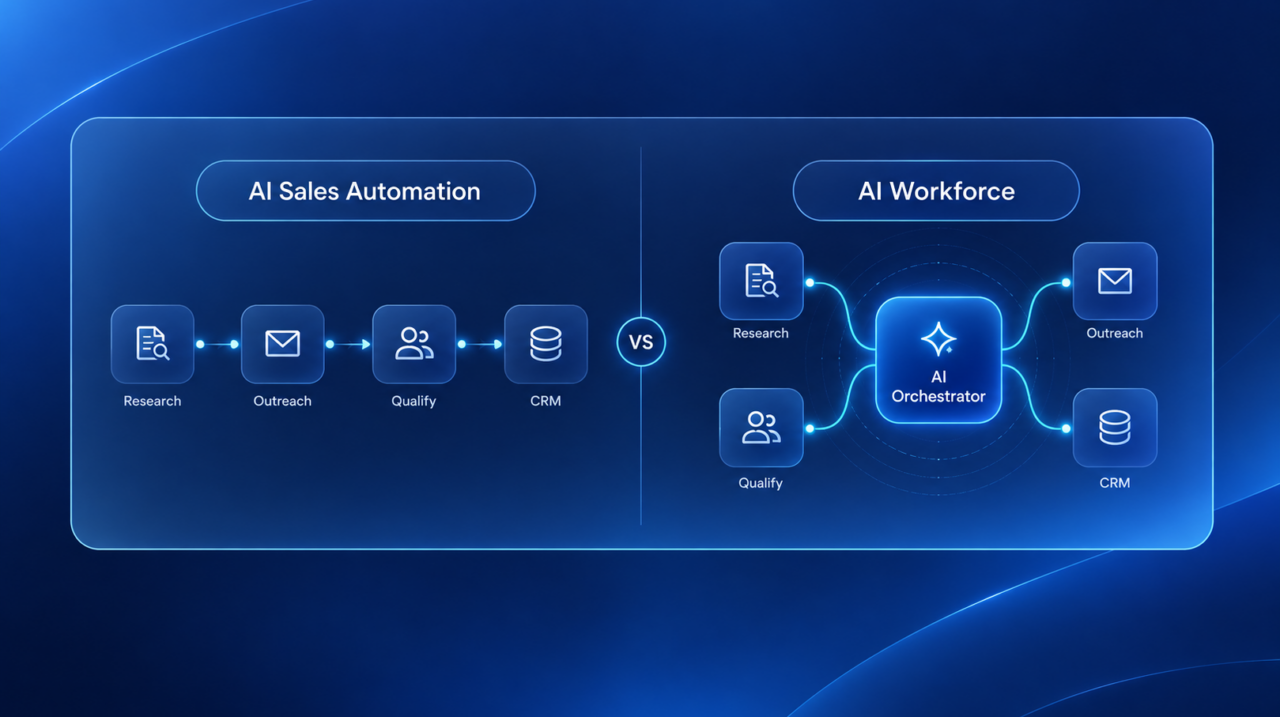
organizations have used automation for years to reduce repetitive work across the sales process. Lead routing, email sequences, meeting reminders, follow-ups, CRM updates, and other routine activities can all run with limited manual involvement. AI has expanded those capabilities by helping systems analyze information, generate content, and support decisions within existing workflows.
An AI workforce introduces a different operating model. Instead of using AI only to improve individual tasks or predefined workflows, organizations can assign specialized AI workers responsibility for parts of sales execution, including prospect research, enrichment, outreach, qualification, scheduling, and CRM operations.
The distinction matters for companies deciding how AI should participate in outbound sales. AI sales automation improves and executes predefined workflows. An AI workforce can take responsibility for defined parts of the sales process, use context to determine the next approved action, coordinate work across multiple stages, and escalate to people when human judgment is required.
Understanding that difference helps organizations determine whether they are simply automating more sales tasks or creating an execution model capable of operating outbound as a connected process.
What Is AI Sales Automation?
AI sales automation combines workflow automation with AI capabilities to reduce manual work across sales processes. Companies define the workflow, while AI supports specific activities within it.
A sales team may automatically add qualified contacts to a sequence, generate personalized messaging with AI, schedule follow-ups based on predefined conditions, update CRM records, or route prospects using established criteria. These systems execute individual actions within a sales process that has already been defined.
This model works well when the expected action is predictable. If a prospect reaching a certain stage should trigger a task, notification, or CRM update, automation can execute that action consistently without requiring manual intervention.
AI can make these workflows more capable, but people still determine how the sales process operates, how stages connect, and how exceptions should be handled.
The limitation becomes clear when the next action depends on context rather than a fixed rule. A workflow can schedule a follow-up after three days, but if the prospect raises an objection, introduces another stakeholder, or asks to reconnect later, the appropriate next step requires interpretation rather than automatic execution.
What Is an AI Workforce for Sales?
An AI workforce consists of specialized AI workers that take responsibility for defined parts of the sales process and coordinate their work around a commercial objective.
In outbound sales, one AI worker may research accounts, another may enrich prospect information, another may execute outreach, and another may interpret responses or coordinate meetings. Each worker operates within a defined role, with permissions and escalation rules governing what it can execute independently and when a person should become involved.
The key difference is responsibility. An AI worker is not limited to performing one isolated action when a trigger occurs. It can receive an objective, evaluate the information available to it, determine which approved action should happen next, and continue operating within its assigned scope.
This is where the difference between AI employees and AI agents becomes important. As AI takes on ongoing responsibilities within the sales process, organizations need to define what each AI worker is responsible for, what it is allowed to do, how its performance is measured, and when a person needs to step in.
An AI workforce brings several of these specialized workers together across different parts of the sales process. Its value comes from how well those workers coordinate their responsibilities and contribute to the same revenue objective, not from how many agents the organization deploys.
AI Sales Automation vs AI Workforce: What Is the Difference?
The main difference between AI sales automation and an AI workforce is the level of responsibility the technology assumes within the sales process.
AI sales automation primarily executes or improves predefined tasks and workflows. Organization determines what should happen, which conditions trigger the action, and how the process should move from one stage to another.
An AI workforce operates at a broader level. Organizations can assign an AI worker responsibility for a defined area of execution and allow it to choose between approved actions based on the context available.
| AI Sales Automation | AI Workforce | |
| Primary role | Automates tasks and predefined workflows | Takes responsibility for defined parts of sales execution |
| How work starts | Usually through rules or triggers | Can work toward an assigned objective |
| Decision-making | Follows predefined conditions | Uses context to choose between approved actions |
| Scope | Usually a task or workflow | Can operate across multiple connected stages |
| Use of context | Uses information required for a specific automation | Maintains context across the responsibility being executed |
| Human involvement | People manage the wider process and exceptions | People define objectives, boundaries, oversight, and escalation |
| Coordination | Connects system actions and workflow steps | Coordinates specialized AI workers across the sales process |
A simple outbound example makes the distinction clearer. Sales automation can take a predefined prospect list, enrich specific fields, place qualified contacts into a sequence, and send follow-ups according to predetermined timing.
An AI workforce can participate before and after those actions. A research worker can evaluate whether a company fits the ICP, an enrichment worker can identify the appropriate stakeholders, an outreach worker can use the resulting account context, and a qualification worker can interpret the prospect’s response before determining whether the conversation should continue within the AI workflow or move to a salesperson.
The difference is not that one model uses AI and the other does not. Sales automation helps execute a predefined process. An AI workforce can take responsibility for defined parts of that process and coordinate the work required to move it forward.
Why Outbound Sales Needs End-to-End Execution
For organizations relying on outbound sales, the objective should not be to manage a collection of separate AI tools and automations across different parts of the process. The stronger operating model is one that can execute outbound as a connected system, from account research and enrichment through outreach, qualification, scheduling, and CRM updates.
Different stages require different types of execution. Some actions are predictable and can run automatically, while others depend on context, interpretation, or escalation to a person. What matters is that these stages operate as one connected process rather than as separate workflows spread across multiple systems.
An AI workforce can coordinate that execution while preserving context as prospects move through the outbound process. Research informs targeting, enrichment supports outreach, prospect responses influence qualification, and qualified opportunities can move to the appropriate salesperson without requiring the sales team to reconstruct the account history at every handoff.
This coordination matters because disconnected sales tools already create additional operational work for sales teams. Adding more AI without connecting context and execution can reproduce the same fragmentation at another layer of the sales stack.
An AI workforce operating system provides the coordination layer for specialized workers, shared context, permissions, workflow state, and human oversight across the outbound process.
For business and sales leaders, the key question is whether the system can move the right prospects through outbound end to end without fragmented handoffs or added operational work.
How Autonoms AI Executes Outbound Sales
Autonoms AI is an AI workforce for outbound execution. It uses specialized AI workers to execute prospect research, enrichment, outreach, qualification, scheduling, and CRM operations across the sales process.
Each AI worker has a defined responsibility, while orchestration coordinates how context, decisions, and workflow state move across outbound execution. This keeps the process connected from prospect identification through qualified sales engagement.
Human oversight remains embedded in the operating model. Teams can define where AI operates independently, where approval is required, and when responsibility should transfer to a Sales Development Representative, Account Executive, sales manager, or another designated owner.
The Autonoms AI operating model brings together specialized AI workers, orchestration, and human oversight within one system for outbound execution.
For sales leaders, the value is coordinated, end-to-end outbound execution with visibility, control, and clear human accountability.
Why Coordination Matters More Than More Automation
AI sales automation and an AI workforce solve different execution problems. Automation works well when the trigger, rule, and expected action are already defined. An AI workforce becomes more relevant when execution depends on context, multiple possible actions, coordination across stages, and clear escalation to people.
In outbound sales, the larger opportunity is not to add more individual automations or AI agents. It is to create an execution system that coordinates the full process while applying the right level of automation, AI decision-making, and human oversight at each stage.
As AI takes responsibility for more parts of sales execution, people no longer need to manage every transition between prospecting, enrichment, outreach, qualification, scheduling, and CRM operations. Those responsibilities can remain connected around the same prospect, shared context, and commercial objective.
The value lies in moving beyond isolated task automation toward coordinated, end-to-end outbound execution.