


 Sep 11,2026
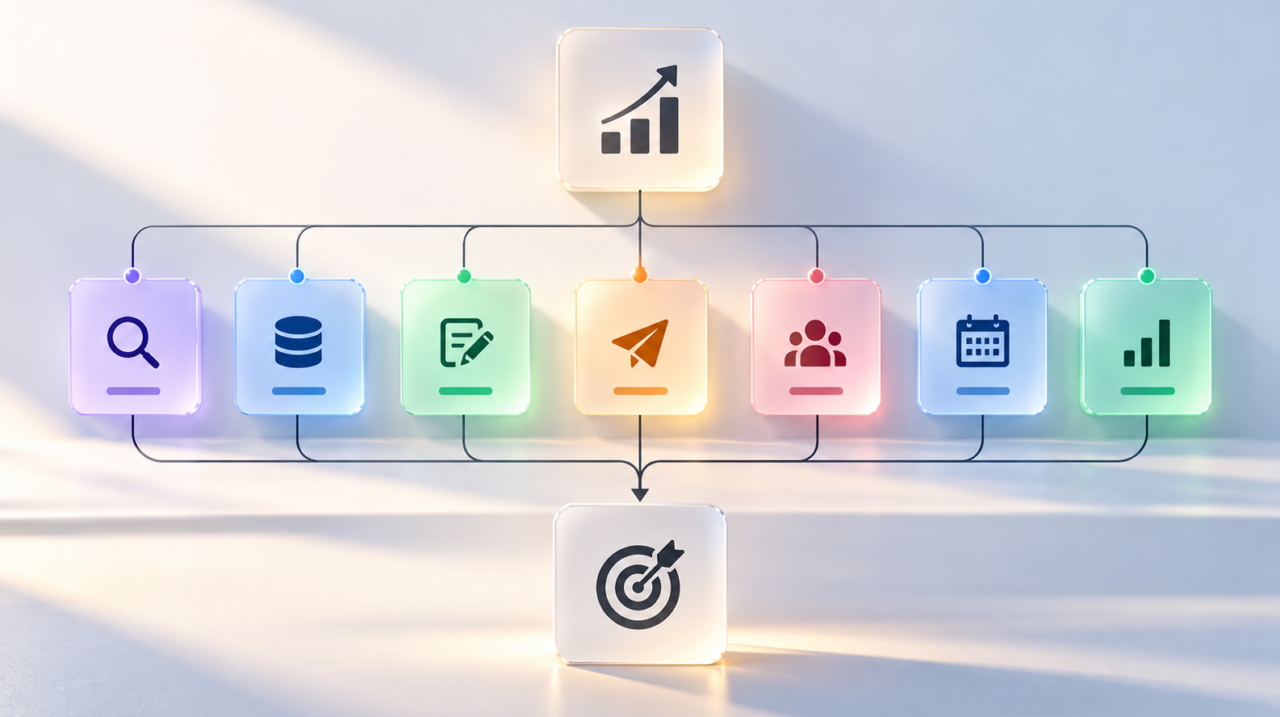
Sales leaders have spent years adding prospecting platforms, enrichment providers, sequencing tools, conversation intelligence, CRM automation, and AI assistants to the revenue stack. AI now creates a different management question. Instead of supporting individual tasks, AI systems can participate directly in prospect research, account prioritization, outreach, qualification, scheduling, and sales operations.
For CROs and other revenue executives, this changes the decision from which AI tool to purchase to which parts of the outbound engine should become machine-executable. Leadership also needs to determine how those systems coordinate their work, how performance is measured, and where people remain responsible for judgment and approval.
An AI workforce for outbound sales provides a model for organizing this new execution capacity. Rather than deploying disconnected AI agents across separate sales activities, revenue teams can assign defined responsibilities to specialized AI workers, coordinate their work across the sales process, and maintain human oversight over commercially sensitive decisions.
Structuring that model requires more than deploying agents. Revenue leaders need an operating structure for machine execution across organization.
What Is an AI Workforce for Outbound Sales?
An AI workforce for outbound sales is a coordinated group of specialized AI workers that execute defined responsibilities across the outbound sales process. These responsibilities can include researching accounts, identifying prospects, enriching data, prioritizing opportunities, preparing outreach, managing follow-ups, qualifying responses, coordinating meetings, and maintaining CRM records.
The operating principle is specialization. A research worker does not need the same responsibilities, permissions, or performance measures as an outreach worker. A qualification worker may need access to prospect responses and qualification criteria, yet it may have no authority to modify commercial terms or make decisions reserved for an account executive.
This model differs from using a collection of independent AI agents. Understanding the difference between AI employees and AI agents becomes relevant once AI begins taking persistent responsibility for parts of a business process. The management requirement expands from whether an agent can perform a task to how several AI workers operate together around a shared revenue objective.
The same shift explains why companies are beginning to think beyond individual agents toward an AI workforce operating system. Once several AI workers participate in the same sales process, the organization needs shared context, permissions, handoffs, workflow rules, visibility, and human escalation paths.
For sales leadership, the objective is not to maximize the number of agents deployed. The objective is to create reliable execution capacity across the revenue engine.
Revenue Leaders Should Think About AI as Sales Capacity
Most sales AI discussions begin with productivity. Revenue executives should look one level higher and consider capacity.
Sales capacity represents how much productive revenue work an organization can execute with its people, systems, data, and budget. A sales team can have experienced sellers and a large technology stack yet remain constrained by the amount of research, data management, follow-up, and coordination required to keep outbound activity moving.
AI introduces another source of capacity. Machine execution can take responsibility for structured work that does not require a seller’s judgment at every stage. Account research can happen continuously. Prospect records can be enriched before sellers need them. Follow-ups can be triggered from prospect activity. CRM records can be updated as work occurs rather than waiting for a salesperson to enter information manually.
This is becoming a broader workforce strategy consideration for executives. Microsoft’s 2025 Work Trend Index reported that 82 percent of leaders expected to use digital labor to expand workforce capacity within the following 12 to 18 months. The research also described emerging organizations in which humans and agents work around outcomes rather than traditional role boundaries.
For revenue leaders, digital labor creates another way to expand sales capacity beyond adding headcount. Before increasing SDR hiring, companies can examine how much of the current workload consists of research, enrichment, follow-up, CRM administration, and other machine-executable tasks.
This changes how revenue teams think about scaling outbound sales without increasing SDR headcount. The question is not whether people are still needed, but which parts of the sales process require human judgment and which can be handled by AI.
Start With the Outbound Operating Model
The wrong starting point is asking what an AI agent can do and searching for somewhere to deploy it. Revenue leaders should begin with the sales operating model.
Map the outbound process from account identification through opportunity creation. Document how an account enters the target universe, how contacts are identified, how data is verified, how prospects are prioritized, how outreach begins, how responses are handled, how qualification occurs, and how resulting information enters the CRM.
Each stage should have a clear input, expected output, owner, and decision rule. Once those elements are visible, leadership can identify which responsibilities require human judgment and which can be delegated to AI.
This matters since outbound is already a connected process. Effective AI-powered outbound sales depends on research, targeting, enrichment, outreach, qualification, and follow-up working from compatible information. Automating one stage without accounting for the stages around it can simply move the constraint elsewhere in the sales process.
A task being technically possible for AI does not mean it should immediately become autonomous. Researching 5,000 accounts has a different commercial risk from communicating with a strategic enterprise prospect. Updating an industry field in a CRM has a different consequence from deciding that a high-value opportunity should be disqualified.
Revenue leadership should classify work based on repeatability, commercial consequence, data requirements, and the amount of judgment involved.
Identify the Sales Work That Should Become Machine-Executable
The most useful AI workforce designs begin with responsibilities that are structured enough to execute consistently and frequent enough to create meaningful capacity.
Several parts of outbound meet those conditions.
Prospect and Account Research
Prospecting creates a significant research burden for sales teams. They need to identify companies that fit the ICP, determine whether those companies meet relevant criteria, find the right people inside the organization, and gather enough commercial context to support outreach.
AI workers can collect and structure that information at a scale that would be difficult to maintain manually. They can evaluate company characteristics, identify relevant roles, summarize account information, and prepare the context required by downstream workflows.
The value is not simply producing more prospect records. Poor account selection reduces the effectiveness of every stage that follows. Improving outbound sales targeting allows sales capacity to be concentrated on accounts with a stronger reason to enter the outbound process.
McKinsey’s research on AI in B2B sales identifies next-best opportunity selection as a key AI use case. AI can combine multiple data sources, accelerate account research, and help sellers prioritize customers and opportunities using more complete information.
Data Enrichment
Prospect information often enters sales systems incomplete. Job titles change, companies grow, contacts move, and records created from different sources use inconsistent fields.
An AI workforce can take responsibility for continuously improving the data required for sales execution. Workers can identify missing information, standardize records, compare details across approved sources, and prepare structured data for segmentation and prioritization.
The business impact of incomplete CRM data extends beyond database administration. Weak data can influence which accounts are selected, how territories are segmented, what personalization is possible, and whether automated decisions are based on the correct prospect context.
When AI becomes an operator of the sales process, data quality becomes part of execution quality.
Account Prioritization
Most outbound teams cannot give every potential account the same level of attention. The question is which accounts should receive resources now.
AI workers can support this decision by evaluating ICP fit, account characteristics, engagement history, available buying signals, and other defined criteria. Instead of producing another static lead score, the system can continuously update which accounts deserve attention as new information becomes available.
This creates a more useful relationship between intelligence and execution. Research determines fit, prioritization determines where capacity should be deployed, and outreach operates from that decision.
The result is an outbound workload organized around commercial relevance rather than list size.
Outreach Execution
Once accounts have been selected and researched, AI workers can participate in email, LinkedIn, and other outbound execution within approved parameters.
This stage should use the information generated earlier in the process. Account characteristics, prospect role, known business context, relevant offer, and campaign rules should influence the communication that reaches each prospect.
That is a deeper form of outbound sales personalization than generating a personalized opening sentence. The objective is to connect who the company targets, why the account is relevant, which offer is appropriate, and how the message should be presented.
AI-generated copy without that context may increase content production without improving sales relevance.
Follow-Ups and Qualification
A significant amount of outbound value can be lost after initial contact. Prospects respond at different times, follow-ups need to reflect previous interactions, replies need classification, and qualified interest needs to move to the correct person.
These activities create strong opportunities for coordinated machine execution. AI workers can monitor responses, identify prospect intent, prepare appropriate follow-up actions, and route conversations based on defined qualification criteria.
A connected workflow for automating prospecting, outreach, and follow-ups becomes more valuable when the underlying workers share prospect context rather than function as isolated automations.
The prospect should not become a new record every time responsibility moves between systems.
Scheduling and CRM Operations
When interest becomes a meeting, the operational work continues. Calendar availability needs to be checked, meetings need to be scheduled, reminders need to be sent, and the CRM should reflect what happened.
An AI workforce can handle much of this coordination in the background. Meeting status, qualification information, outreach history, and next steps can be returned to the revenue system without depending on a salesperson to recreate the activity manually.
This closes a common execution gap. The AI workforce does not simply generate activity at the top of the funnel. It maintains continuity as the prospect moves through the outbound process.
Give AI Workers Defined Roles
Revenue organizations should resist the temptation to create one general agent responsible for everything in outbound.
Specialization creates clearer operational boundaries. A prospect research worker can be evaluated on the relevance and completeness of the accounts it identifies. An enrichment worker can be evaluated on data accuracy and coverage. An outreach worker can be measured on successful execution and prospect response. A qualification worker can be evaluated on routing accuracy and qualified conversations.
Defined roles make permissions easier to manage. A research worker may access prospecting and enrichment sources yet have no permission to communicate with a prospect. An outreach worker may execute approved messaging but have no authority to change an opportunity’s commercial status. A CRM worker may update defined fields without having access to communication channels.
This creates a management structure similar to how revenue organizations already think about human responsibility. Role, access, expected output, and escalation path are defined before execution begins.
The concept of persistent AI employees becomes more relevant at this stage. AI workers have greater operational value when they own repeatable responsibilities inside a broader process rather than appearing only when someone manually prompts them.
Coordination Matters More Than Agent Count
Specialized workers create value only when their work remains coordinated.
Five AI workers operating independently can recreate the same fragmentation that already exists across many sales technology stacks. Research may remain in one environment, enrichment in another, messaging in another, and qualification context somewhere else.
Revenue teams already experience the cost of disconnected sales tools when sellers have to move information manually between prospecting platforms, sequencing tools, calendars, and CRMs. Adding disconnected agents on top of those systems does not solve the structural problem.
An orchestration layer should manage how work moves between AI workers. It needs to know which worker acts next, which context travels with the prospect, what event triggers another action, when execution should stop, and when a person should be brought into the process.
Consider an account that enters an outbound workflow. A research worker determines whether it meets ICP criteria. An enrichment worker identifies relevant contacts. A prioritization process determines whether the account should be activated. An outreach worker executes communication. A qualification worker interprets a response. A scheduling worker coordinates a meeting. A CRM worker records the resulting activity.
Each worker may perform a narrow responsibility, yet the revenue outcome depends on the complete chain.
This is why the number of deployed agents is a weak measure of AI maturity. Coordination quality matters more.
Human Oversight Should Be Part of the Architecture
Sales AI is often discussed as a choice between manual work and full autonomy. organizations need a more practical operating model.
Some sales activities can run with high levels of machine execution. Routine research, standardized enrichment, activity logging, and defined CRM updates may require limited intervention when confidence thresholds and validation rules are met.
Other activities carry greater commercial consequences. Messaging a named enterprise account, handling an unusual prospect response, discussing pricing, responding to an objection involving legal terms, or making a judgment about a strategic opportunity may need human review.
The right level of oversight depends on the decision being made, not on a blanket policy that treats every AI action the same way.
Human oversight should define at least four things: what AI can execute independently, which actions require approval, what conditions trigger an escalation, and who owns the decision after escalation.
The objective is not to create a manual approval queue around every action, since that would preserve much of the operational burden the AI workforce is intended to reduce. Human attention should be concentrated where judgment, commercial context, relationships, and accountability create the most value.
For senior sales leaders, oversight is also a matter of visibility. Executives should be able to see what AI workers are doing, which accounts they are acting on, which decisions are being escalated, and what outcomes those actions produce.
RevOps Becomes Central to AI Workforce Operations
As AI assumes more execution responsibility, RevOps becomes increasingly important to the operating model.
AI workers rely on definitions that RevOps already manages or influences. These include lifecycle stages, routing rules, account ownership, qualification criteria, required CRM fields, segmentation logic, sales process definitions, and reporting standards.
An AI system cannot reliably operate a sales process if those definitions conflict across systems.
This creates a broader role for AI in RevOps. RevOps can move from administering the tools used by human sellers toward helping define the operating environment used by both human and AI workers.
That includes determining which systems AI can access, which fields it can modify, how data should move between systems, what actions need logging, and how machine performance should appear in revenue reporting.
The relationship between the CRO and RevOps may become especially important here. The CRO defines commercial objectives and acceptable risk. RevOps translates those objectives into workflows, permissions, data structures, and measurable operating rules.
Measure Revenue Outcomes, Not AI Activity
AI can generate activity at a scale that makes raw volume a weak executive measure. An AI workforce may research thousands of accounts, enrich thousands of records, and execute large volumes of outreach, but those figures alone do not show whether the revenue system is performing better.
CROs should connect AI workforce performance to pipeline quality, sales capacity, and the economics of execution. Relevant measures can include the percentage of target accounts successfully researched, qualified accounts identified, positive response rates, qualified conversations, meetings created, meeting-to-opportunity conversion, pipeline generated, cost per qualified opportunity, and seller time redirected from repetitive execution.
Operational measures still matter. Escalation rates, execution errors, CRM accuracy, task completion, and response times can help RevOps identify where the system is underperforming. These measures should support the commercial scorecard rather than replace it.
McKinsey’s research on AI across the B2B sales cycle found that AI can support areas such as account prioritization, research, next-best actions, and seller productivity. In one case cited by the firm, an AI-enabled growth engine increased conversion rates by 40 percent and improved lead execution speed by 30 percent.
For revenue leaders, the question is simple: is AI helping the sales organization create more qualified pipeline, faster and at a better cost?
Introduce AI Workforce Execution in Controlled Stages
Revenue leaders do not need to shift the entire outbound operation to AI at once. A narrower starting point allows the organization to establish a performance baseline and evaluate how AI execution affects a defined part of the sales process.
The company might begin with one ICP segment, territory, product line, or outbound motion. Initial execution can focus on research and enrichment before expanding into prioritization, outreach, response classification, scheduling, and CRM operations.
Each expansion should have defined performance requirements. Leadership should know whether targeting accuracy improved, sellers received better account context, response handling became faster, CRM completeness increased, and more qualified pipeline was created with the available sales capacity.
A controlled rollout also gives the team time to refine human oversight. Escalation rules that appear appropriate during planning may need adjustment once real prospect interactions begin moving through the system.
The objective is measurable adoption rather than expanding AI execution before its commercial impact is clear.
How AI Changes the Role of the CRO
An AI workforce introduces a new management responsibility for revenue leadership.
CROs have traditionally managed human capacity through headcount planning, territories, quotas, compensation, enablement, and performance management. AI adds another form of capacity that requires its own scope, objectives, permissions, operating rules, and performance standards.
This creates a new set of executive decisions. Which parts of pipeline generation should run continuously without human initiation? Which accounts require human approval before outreach? Which activities should remain within defined AI workflows, and when should an AI worker escalate to a Sales Development Representative, Account Executive, or sales manager? Revenue leaders also need to determine which performance thresholds justify expanding machine execution across the sales process.
The role of the CRO extends beyond deciding where AI should operate. Sales leadership also needs to determine how people should use the capacity AI creates. Removing hours of research, administrative work, and coordination has limited value if the organization has no clear plan for how sellers should reinvest that time in higher-value sales activity.
McKinsey’s analysis of AI in the future of B2B sales describes a shift from AI supporting individual tasks to becoming more embedded in sales operations, giving sellers more time for work that depends on trust, complex problem-solving, and customer relationships.
For CROs, the opportunity is to define the division of work deliberately: what AI should execute, what people should own, and how both forms of capacity contribute to pipeline and revenue performance.
How Autonoms AI Supports AI Workforce Operations for Outbound Execution
Autonoms AI approaches outbound execution as an AI workforce operations problem rather than a single-agent problem.
Specialized AI workers can participate across prospect research, enrichment, outreach, qualification, scheduling, and CRM operations. An orchestration layer coordinates how work moves across those responsibilities so that prospect context and workflow state remain connected throughout the process.
Human oversight is part of that operating model. Teams can maintain visibility into AI activity and retain control over work that requires human review, judgment, or intervention.
This structure allows companies to use AI as execution capacity without turning the revenue organization into a collection of independent automations. The broader Autonoms AI model combines specialized AI employees, coordinated execution, and human oversight around defined business outcomes.
For a revenue leader, that operating structure matters more than whether an individual AI agent can write an email or research an account. The commercial value comes from how those capabilities work together across the revenue process.
Structuring an AI Workforce Around Revenue Outcomes
An AI workforce for outbound sales should begin with the revenue operating model, not the number of agents a company wants to deploy. Leadership needs to identify which work should become machine-executable, assign clear responsibilities, connect AI workers to reliable data, coordinate their actions, and define where human judgment remains necessary.
This changes the way sales capacity can be designed. Research, enrichment, account prioritization, outreach, follow-up, qualification, scheduling, and CRM operations can function as parts of one execution system rather than a series of disconnected tasks distributed across people and tools.
Human sellers remain central where their judgment creates the most commercial value. AI workers can take responsibility for structured execution that consumes time and limits coverage. RevOps can define the systems, data, and workflow rules that connect both sides of the workforce. Revenue leadership can manage the resulting capacity against pipeline and efficiency targets.
As the amount of sales work performed by AI grows, the management problem moves beyond individual agent capability. An AI workforce operating system provides the operating layer for coordinating AI workers, shared context, permissions, execution workflows, and human oversight across the revenue process.