

The Complete Guide to AI-Powered Outbound Sales

 Jul 17,2026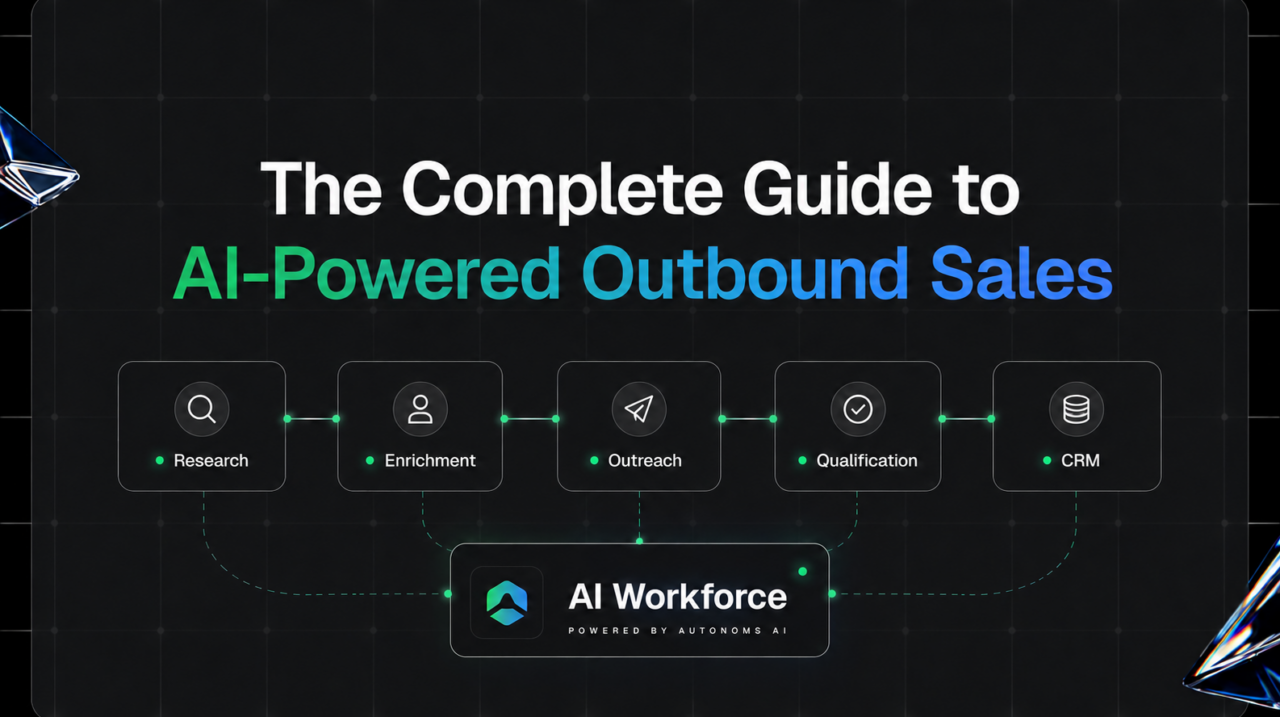
Outbound sales remains one of the most effective ways for businesses to reach potential customers, generate qualified opportunities and build a predictable sales pipeline.
However, traditional outbound sales can be difficult and expensive to scale. Sales teams spend significant time researching prospects, finding contact information, writing messages, sending follow-ups, qualifying leads, scheduling meetings and updating the CRM.
These activities are necessary, but they also reduce the amount of time sales representatives can spend having meaningful conversations with prospective customers.
AI-powered outbound sales changes this by using artificial intelligence to automate and coordinate repetitive sales activities. Instead of relying on sales representatives to execute every step manually, businesses can use AI to support prospect research, personalised outreach, lead qualification, meeting scheduling and CRM management.
This guide explains how AI-powered outbound sales works, where it can be applied and how businesses can use it without losing human control.
What Is AI-Powered Outbound Sales?
AI-powered outbound sales is the use of artificial intelligence to identify potential customers, research accounts, personalise outreach, manage follow-ups, qualify interested prospects and move opportunities through the sales pipeline.
Traditional sales automation generally follows predefined instructions. For example, it may send an email three days after a prospect is added to a sequence.
AI-powered outbound sales goes further. It can analyse information, interpret context, prioritise leads, create personalised messages and determine the appropriate next action based on a prospect’s behaviour.
An AI-powered outbound system may help a business:
- Define its ideal customer profile
- Find companies that match that profile
- Identify relevant decision-makers
- Enrich prospect and company information
- Score and prioritise potential customers
- Personalise email and LinkedIn messages
- Manage follow-up sequences
- Conduct or support cold calls
- Qualify interested prospects
- Schedule meetings
- Update CRM records
- Track outbound performance
The objective is not simply to send more messages. It is to create a more efficient outbound process that helps sales teams reach suitable prospects with relevant communication.
Why Traditional Outbound Sales Is Difficult to Scale
Outbound sales involves more work than sending cold emails or making calls. Before a sales representative contacts a prospect, they may need to research the company, confirm the person’s role, understand the company’s needs and find accurate contact details.
Once outreach begins, the representative must monitor responses, send follow-ups, answer questions, qualify interest, arrange meetings and record every activity.
As the number of prospects increases, the amount of administrative work increases with it.
Prospect research takes time
Sales representatives often search company websites, LinkedIn profiles, industry directories and other sources to understand potential customers.
This research improves personalisation, but conducting it manually for hundreds of prospects can consume a significant portion of the working day.
Personalisation is difficult at scale
Generic outreach is easier to produce, but it often fails to demonstrate an understanding of the prospect’s business.
Meaningful personalisation requires information about the company, its industry, recent activities, challenges and potential needs. Producing this level of personalisation manually becomes difficult when a team is contacting many prospects.
Follow-ups are inconsistent
Not every prospect responds to the first message. Effective outbound sales often requires several well-timed follow-ups across different channels.
When representatives manage this manually, some prospects may receive late follow-ups while others may be forgotten entirely.
CRM administration reduces selling time
Every call, email, response, meeting and change in lead status must be recorded accurately.
When CRM updates depend entirely on manual entry, records can become incomplete or outdated. This makes it harder for managers to understand what is happening across the pipeline.
Increasing activity often requires additional headcount
A company that wants to contact more prospects may assume it needs to hire more sales development representatives.
Hiring can increase capacity, but it also introduces additional costs for recruitment, onboarding, training, management, software and compensation.
AI-powered outbound sales provides another way to expand execution capacity without making headcount the only path to growth.
How AI Is Used Across the Outbound Sales Process
AI can support almost every stage of outbound sales, from identifying prospects to maintaining accurate CRM records.
The most effective approach is to apply AI across a connected workflow rather than using unrelated tools for isolated tasks.
1. Ideal Customer Profile Development
A successful outbound strategy begins with a clear ideal customer profile.
An ideal customer profile describes the type of organisation most likely to need and benefit from a company’s solution. It may include:
- Industry
- Company size
- Revenue range
- Location
- Technology used
- Growth stage
- Business model
- Relevant hiring or buying signals
- Common operational challenges
AI can analyse existing customer data to identify shared characteristics among high-value or successful customers. This information can help a business refine its targeting and avoid spending resources on unsuitable accounts.
Human input remains important because sales leaders understand the company’s goals, positioning and market priorities. AI should strengthen that judgment, not replace it.
2. Prospect Research and Data Enrichment
Research is one of the most time-consuming parts of outbound sales.
AI can collect and organise relevant information about companies and decision-makers before outreach begins. Depending on the available data and permissions, this may include:
- Company size and industry
- Office locations
- Products and services
- Decision-maker roles
- Publicly available company developments
- Technology used
- Hiring activity
- Contact information
- Potential business challenges
This gives sales teams a stronger foundation for deciding who to contact and what message to send.
Instead of beginning every interaction with a blank page, representatives can review organised prospect information and concentrate on strategic conversations.
3. Lead Scoring and Prioritisation
Not every prospect deserves the same level of attention.
AI can evaluate prospects using criteria such as their fit with the ideal customer profile, available buying signals, previous engagement and likelihood of needing the solution.
The resulting lead score can help teams prioritise:
- High-fit accounts that should receive immediate attention
- Prospects requiring additional research
- Leads that should remain in a nurturing sequence
- Accounts that do not meet the targeting criteria
Lead scoring helps prevent sales teams from treating a long contact list as though every name represents an equal opportunity.
However, the scoring system should remain transparent. Sales leaders should understand the factors affecting each score and be able to adjust the criteria when business priorities change.
4. Personalised Email Outreach
AI can use prospect research to create email messages that reflect the recipient’s role, company and likely priorities.
This is different from inserting a first name into a generic template. Effective AI-supported personalisation may reference:
- The prospect’s responsibilities
- The company’s industry
- A relevant operational challenge
- A public company development
- A specific reason the solution may be relevant
For example, a founder may receive a message focused on scaling sales execution without rapidly expanding headcount. A RevOps leader may receive a message focused on workflow coordination, data accuracy and CRM management.
These messages can follow the same campaign strategy while addressing the needs of different decision-makers.
Every message should still follow the company’s brand guidelines and outreach policies. Important or sensitive campaigns may require human approval before they are sent.
5. LinkedIn Outreach
LinkedIn can support account research, professional engagement and direct outreach.
AI can help sales teams organise LinkedIn activities by:
- Identifying relevant decision-makers
- Reviewing publicly available profile information
- Suggesting personalised connection messages
- Preparing follow-up messages
- Coordinating LinkedIn outreach with email campaigns
- Recording engagement in the CRM
The purpose should not be to produce large volumes of generic messages. LinkedIn outreach is more effective when it is relevant, appropriately timed and connected to the wider account strategy.
Businesses must also ensure that their processes comply with LinkedIn’s rules and applicable data-protection requirements.
6. Automated Follow-Ups
A prospect may be interested but unable to respond immediately. They may also need additional information before agreeing to a conversation.
AI-powered follow-up systems can monitor previous interactions and determine the appropriate next step.
Follow-ups may vary according to whether the prospect:
- Opened or responded to a message
- Requested more information
- Asked to be contacted later
- Expressed interest in a particular service
- Booked a meeting
- Did not attend a scheduled meeting
- Asked not to be contacted again
This creates a more responsive process than sending identical messages to every prospect on fixed dates.
It also helps ensure that interested prospects do not disappear from the pipeline because a representative forgot to follow up.
7. AI-Powered Cold Calling
Voice AI can support outbound calling by conducting initial conversations, asking predefined qualification questions and recording the outcome.
Depending on the company’s process, an AI voice system may:
- Introduce the reason for the call
- Confirm whether it is speaking with the appropriate person
- Ask basic qualification questions
- Provide approved information
- Identify interest
- Offer available meeting times
- Transfer suitable conversations to a human representative
- Record the outcome in the CRM
Human oversight is especially important for voice communication. Companies should establish clear boundaries for what the system can say, when it must transfer a conversation and how consent, disclosure and local calling regulations will be handled.
AI should not pretend to be human. Prospects should be able to understand that they are interacting with an AI system.
8. Lead Qualification
Generating responses is not the same as generating qualified opportunities.
AI can support lead qualification by collecting information about the prospect’s needs, authority, timing and current process.
For example, it may determine:
- Whether the organisation matches the target customer profile
- What problem the prospect is trying to solve
- Whether there is an active initiative
- Who is involved in the buying decision
- When the organisation expects to act
- Whether a conversation with the sales team is appropriate
Qualified opportunities can then be transferred to a human representative with the relevant context already organised.
This allows salespeople to begin meetings with a clearer understanding of the prospect instead of repeating every introductory question.
9. Meeting Scheduling and Reminders
Coordinating meetings can involve several emails, especially when participants are in different time zones.
AI can connect with approved calendars to:
- Present available meeting times
- Recognise the prospect’s time zone
- Schedule meetings
- Send calendar invitations
- Deliver reminders
- Reschedule cancelled meetings
- Follow up after missed meetings
- Record the meeting in the CRM
This reduces unnecessary back-and-forth and makes it easier for interested prospects to take the next step.
10. CRM Management
CRM accuracy is essential for sales forecasting, performance analysis and effective follow-up.
AI can reduce manual CRM work by recording activities and updating lead information after emails, calls and meetings.
It may update:
- Contact information
- Account information
- Lead status
- Last interaction
- Next action
- Meeting details
- Qualification notes
- Conversation summaries
- Follow-up dates
Sales teams should establish rules governing which fields AI can update automatically and which changes require human review.
AI Sales Tools vs. an AI Workforce
Many sales teams already use software for prospecting, email sequences, calling, scheduling and CRM management.
These tools are useful, but they often operate separately. A representative may still need to move information between systems, monitor every campaign and decide what happens next.
An AI workforce takes a more coordinated approach.
Rather than relying on one general-purpose assistant, an AI workforce can include specialist AI employees assigned to different responsibilities. One may conduct prospect research, another may enrich data, another may personalise outreach and another may manage scheduling or CRM updates.
An orchestrator coordinates these AI employees and ensures that work moves through the appropriate sequence.
For example:
- A research AI employee identifies suitable companies.
- An enrichment AI employee finds and verifies relevant information.
- A lead-scoring AI employee prioritises the prospects.
- An outreach AI employee prepares and sends approved communication.
- A qualification AI employee evaluates responses.
- A scheduling AI employee arranges meetings.
- A CRM AI employee records activities and outcomes.
This creates a connected operating system for outbound execution rather than a collection of isolated automation tools.
Benefits of AI-Powered Outbound Sales
Greater execution capacity
AI can manage repetitive activities across a larger number of prospects, enabling companies to expand outbound execution without increasing headcount at the same rate.
More time for human selling
When AI handles research, data entry, scheduling and routine follow-ups, sales representatives can focus on discovery calls, relationship-building, negotiation and closing.
Better personalisation
AI can analyse prospect information and adapt messages to different roles, industries and business needs.
Faster lead response
Interested prospects can receive timely replies, qualification questions and scheduling options without waiting for a representative to become available.
More consistent follow-ups
Automated workflows help ensure that every suitable prospect receives the appropriate follow-up at the right stage of the process.
Improved CRM accuracy
Automatically recording activities can reduce incomplete records and give sales leaders a clearer view of pipeline activity.
More predictable execution
AI cannot guarantee revenue, but it can make the activities supporting pipeline generation more consistent, measurable and easier to manage.
Risks and Limitations of AI-Powered Outbound Sales
AI-powered outbound sales should not be treated as an unsupervised volume engine.
Without proper controls, businesses may create poor customer experiences or damage their reputation.
Generic or inaccurate messages
AI-generated messages can still contain irrelevant or incorrect information. Businesses should use verified data, approved messaging and quality controls.
Excessive outreach
Increasing execution capacity does not justify contacting unsuitable prospects or sending too many messages. Outreach volume should be governed by relevance, channel rules and applicable regulations.
Loss of brand consistency
If an AI system is not trained on the company’s positioning and communication standards, its messages may not reflect the brand accurately.
Poor-quality data
AI cannot solve every data problem. Inaccurate or incomplete prospect information can lead to weak targeting and ineffective communication.
Inadequate human oversight
Sensitive conversations, unusual requests and important decisions may require human judgment. Businesses must define when an AI employee can act independently and when approval is required.
Why Human Oversight Still Matters
The purpose of AI-powered outbound sales is to improve execution, not remove accountability.
Human oversight helps ensure that:
- Targeting matches the company’s strategy
- Messages remain accurate and appropriate
- Brand standards are followed
- Sensitive conversations are escalated
- Prospects’ preferences are respected
- Performance is reviewed regularly
- AI actions remain visible and accountable
Human-in-the-loop systems can assign an owner or backup reviewer to important decisions. This gives businesses the speed of AI execution while retaining human control.
How to Introduce AI Into Your Outbound Sales Process
Businesses do not need to automate their entire sales process immediately.
A structured implementation can begin with the following steps.
1. Review the existing outbound process
Document how the team currently identifies prospects, conducts research, sends outreach, qualifies leads, schedules meetings and updates the CRM.
Identify delays, repetitive tasks and activities that consume the most time.
2. Define the desired outcome
Choose a specific business objective, such as:
- Increasing qualified meetings
- Improving follow-up consistency
- Reducing manual research
- Expanding outbound capacity
- Improving CRM accuracy
- Reducing the cost of repetitive sales work
A clear objective makes it easier to determine whether AI is producing value.
3. Select the first workflow
Begin with a defined workflow rather than applying AI everywhere at once.
For example, a business could start with prospect research and enrichment before extending AI into outreach, qualification and scheduling.
4. Establish rules and approval points
Determine what AI can do automatically and what requires human review.
These rules may cover targeting, message approval, data handling, call transfers, meeting scheduling and CRM updates.
5. Connect the necessary systems
AI-powered workflows may need approved access to sales tools, calendars, communication channels and the CRM.
These connections should follow appropriate security and permission controls.
6. Monitor performance
Track indicators such as:
- Qualified response rate
- Meetings booked
- Meeting attendance rate
- Lead-to-opportunity conversion
- Follow-up completion
- CRM data accuracy
- Time saved
- Cost per qualified opportunity
Activity volume alone does not show whether the outbound process is working.
7. Improve the workflow continuously
Review results, identify weak points and refine the targeting, messaging, qualification criteria and approval process.
AI-powered outbound sales performs best when it is treated as an operating system that improves through structured feedback.
How Autonoms AI Supports Outbound Sales
Autonoms AI provides a coordinated AI workforce for outbound sales execution.
Instead of asking sales teams to manage disconnected tools for each task, Autonoms AI brings specialist AI employees together within one orchestrated system.
These AI employees can support:
- Prospect and account research
- Data enrichment
- Lead scoring and prioritisation
- Personalised email outreach
- LinkedIn outreach
- Cold calling
- Lead qualification
- Meeting scheduling
- Follow-ups
- CRM updates and hygiene
The orchestrator coordinates how tasks move between AI employees, while human-in-the-loop oversight helps ensure that important decisions remain under human control.
This enables companies to increase outbound execution capacity without making additional headcount the only way to scale.
Build a More Scalable Outbound Sales System
Outbound sales does not have to depend on representatives completing every research, outreach, follow-up and administrative task manually.
AI-powered outbound sales allows businesses to coordinate these activities across a connected workflow. With specialist AI employees, orchestration and human oversight, companies can increase execution capacity while maintaining control over how prospects are contacted and qualified.
Autonoms AI helps organisations turn outbound sales into a coordinated, measurable and continuously operating system.
Ready to scale outbound execution without scaling headcount at the same rate?
Visit https://autonoms.ai/ to discover how a coordinated AI workforce can support your outbound sales process.