


 Jul 10,2026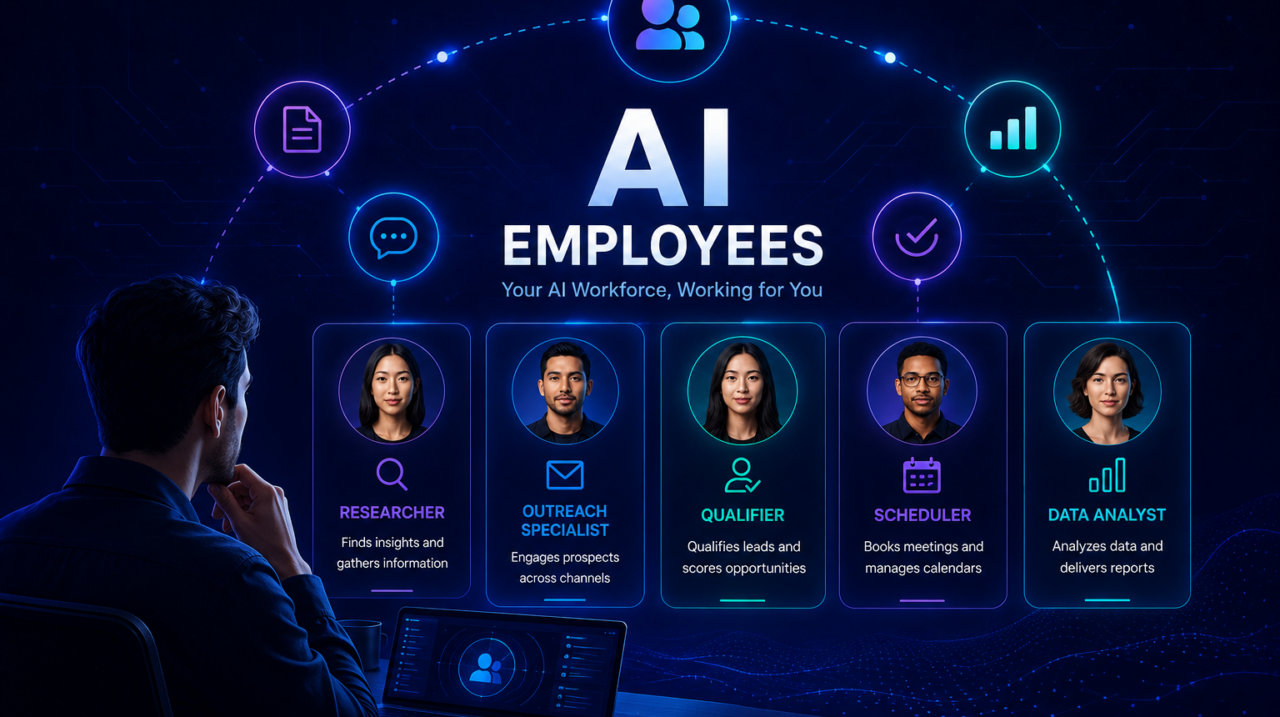
Businesses are beginning to use artificial intelligence in a more structured and purposeful way. Instead of treating AI as a general tool that anyone can use for any task, companies are assigning AI systems to specific roles and responsibilities.
One AI system may support research, another may manage scheduling, while others may summarize customer conversations, update business records, prepare reports, or assist with routine workflows.
This role-based approach has led to the emergence of AI employees. AI employees are AI agents designed to support specific business functions and responsibilities. They are not human employees, and they do not remove the need for human leadership, judgment, accountability, creativity, or relationships. Instead, they function as digital workers that help teams complete repetitive, process-driven, and information-heavy tasks more efficiently.
The value of an AI employee goes beyond answering questions or generating content. An AI employee can be assigned work, connected to company systems, guided by business rules, and supervised by human team members. This allows businesses to increase their execution capacity while maintaining visibility and control over how work is completed.
Understanding AI Employees
AI employees are role-based AI agents designed to help businesses perform specific tasks across workflows, departments, and systems.
An AI employee may support functions such as research, customer service, sales, scheduling, reporting, recruitment screening, operations tracking, or data management. Instead of relying on one general AI assistant to handle every task, businesses can assign different AI employees to specific roles and responsibilities.
For example, a business may use:
- An AI researcher to gather and summarize information
- An AI scheduler to arrange meetings
- An AI support assistant to draft customer responses
- An AI recruiter to review applications and prepare candidate summaries
- An AI reporting assistant to prepare updates from business data
Each AI employee should have a clearly defined role, specific instructions, access to the appropriate tools and information, and clear limits on what it can do.
How Do AI Employees Work?
AI employees work by combining defined instructions, access to business information, connected tools, and automated workflows.
Each AI employee is assigned a specific role and given clear guidance on the tasks it should perform. It may also be connected to systems such as customer relationship management software, email platforms, calendars, databases, messaging tools, or reporting dashboards.
For example, an AI sales assistant may research prospects, update lead records, draft outreach messages, and notify a human team member when a prospect responds. An AI recruitment assistant may review applications, organize candidate information, prepare summaries, and support interview scheduling.
The way an AI employee works usually includes four main elements:
- A defined role: The AI employee is assigned a specific responsibility or area of work.
- Clear instructions: It follows business rules, processes, and guidelines.
- Access to tools and data: It connects to the systems and information required to complete its tasks.
- Human oversight: People review important actions, manage exceptions, and remain accountable for decisions.
This structure allows AI employees to support ongoing business processes rather than functioning only as tools that respond to individual prompts.
What Can AI Employees Do?
AI employees can support a wide range of business activities, depending on their assigned roles, instructions, and access to company systems.
They are particularly useful for repetitive, process-driven, and information-heavy work that follows clear steps. Their responsibilities may include collecting information, organizing data, preparing documents, monitoring workflows, communicating updates, and completing routine administrative tasks.
Common examples include:
- Researching companies, markets, prospects, or industry trends
- Updating customer, sales, or operational records
- Drafting emails, reports, summaries, and internal documents
- Scheduling meetings and sending reminders
- Reviewing applications and organizing candidate information
- Responding to common customer questions
- Tracking tasks, deadlines, and workflow progress
- Preparing performance reports from business data
- Moving information between connected systems
- Notifying human team members when action or approval is required
The tasks assigned to an AI employee should match the business process it is designed to support. While some AI employees may handle a single responsibility, others may complete several connected tasks within a broader workflow.
AI Employees vs. AI Assistants
AI employees and AI assistants can both help people complete tasks, but they are designed to work in different ways.
A general AI assistant usually responds when a user gives it a prompt or asks a question. It may help write content, summarize information, generate ideas, or provide answers, but it often depends on the user to direct each step.
An AI employee is designed around a specific business role or responsibility. It can follow defined processes, use connected tools, access approved business information, and complete tasks across a workflow.
For example, a general AI assistant may help draft a sales email when asked. An AI sales employee may research a prospect, review company information, prepare a personalized message, update the lead record, and notify a sales representative when a response is received.
The main difference is that an AI assistant supports individual requests, while an AI employee is structured to support ongoing business responsibilities.
This does not mean AI employees operate without human involvement. Human team members still define their roles, set rules, review important actions, manage exceptions, and remain accountable for outcomes.
Benefits of AI Employees
AI employees can help businesses increase their capacity to complete work without immediately increasing headcount. By supporting repetitive, process-driven, and information-heavy tasks, they allow human teams to spend more time on work that requires judgment, creativity, leadership, and relationship-building.
Key benefits include:
- Increased productivity: AI employees can complete routine tasks faster and support multiple workflows at the same time.
- Consistent execution: They can follow defined instructions and business rules across repeated tasks.
- Reduced manual work: They can handle activities such as data entry, scheduling, research, reporting, and record updates.
- Faster response times: AI employees can process information, prepare updates, and support customer or internal requests more quickly.
- Improved workflow visibility: Their activities can be tracked, reviewed, and measured within connected systems.
- Greater scalability: Businesses can increase execution capacity without relying only on additional hires or disconnected tools.
- Continuous support: AI employees can support approved workflows outside regular working hours when required.
The value of AI employees depends on how well they are designed, connected, and supervised. Clear roles, reliable information, appropriate system access, and human oversight are necessary to ensure they support the business effectively.
Limitations of AI Employees
AI employees can support many business processes, but they should not be treated as independent replacements for human judgment, leadership, or accountability.
Their performance depends on the quality of their instructions, the accuracy of the information they can access, and the reliability of the systems connected to them. If an AI employee receives incomplete data or unclear guidance, it may produce incorrect, inconsistent, or unsuitable results.
Common limitations include:
- Limited judgment: AI employees may struggle with complex situations that require context, empathy, or careful interpretation.
- Dependence on data: Their outputs are influenced by the quality and accuracy of the information available to them.
- Potential errors: AI employees can misunderstand instructions or generate inaccurate information.
- Security and privacy risks: Access to business systems and sensitive information must be carefully controlled.
- Difficulty handling exceptions: Unusual situations may require human review or intervention.
- Lack of accountability: Responsibility for decisions and outcomes must remain with the business and its human team members.
For these reasons, businesses should establish clear approval processes, access controls, monitoring systems, and escalation procedures. Human team members should review important actions, manage sensitive situations, and remain responsible for final decisions.
How to Introduce AI Employees Into a Business
Introducing AI employees should begin with a clear business need rather than the technology itself. Companies should first identify tasks that are repetitive, process-driven, time-consuming, or dependent on large amounts of information.
A practical implementation process includes:
- Identify the workflow: Choose a business process where AI can provide clear value.
- Define the role: Specify the responsibilities, tasks, and expected outcomes of the AI employee.
- Set clear instructions: Provide business rules, operating procedures, communication guidelines, and performance standards.
- Connect the right tools: Give the AI employee controlled access to the systems and information required for its role.
- Establish limits: Define which actions it can complete independently and which require human approval.
- Test the workflow: Begin with a limited use case and review the quality, accuracy, and consistency of its work.
- Monitor performance: Track activities, errors, completion rates, response times, and business outcomes.
- Improve over time: Update instructions, workflows, and system access based on performance and feedback.
Businesses should avoid assigning broad or unclear responsibilities at the beginning. Starting with a specific role and measurable tasks makes it easier to evaluate performance, manage risks, and expand the AI employee’s responsibilities gradually.
Examples of AI Employees Across Business Functions
AI employees can be designed to support different departments based on their workflows, responsibilities, and business needs. Their roles may vary from completing a single task to coordinating several connected activities within a process.
Sales
AI employees can support prospect research, lead enrichment, outreach preparation, response qualification, meeting scheduling, pipeline updates, and CRM management. They can also notify sales representatives when a prospect requires human attention.
Marketing
AI employees can assist with audience research, content planning, campaign coordination, performance reporting, social media support, email marketing, and the organization of customer and market insights.
Customer Support
An AI support employee can respond to common questions, summarize customer conversations, organize support requests, retrieve relevant information, and escalate complex issues to human team members.
Recruitment and Human Resources
AI employees can help review applications, organize candidate information, prepare candidate summaries, schedule interviews, answer routine employee questions, and support onboarding processes.
Operations
An AI operations employee can monitor workflows, track task progress, update records, prepare internal reports, identify delays, and notify team members when action is required.
Finance and Administration
AI employees can assist with invoice processing, expense organization, payment reminders, data entry, document preparation, and routine financial reporting.
Research and Reporting
An AI research employee can gather information from approved sources, summarize findings, compare data, monitor industry developments, and prepare structured reports for human review.
How Businesses Manage Multiple AI Employees
As businesses introduce more AI employees, coordination becomes important. Each AI employee may have a different role, access different systems, and support a separate part of the workflow.
Without clear management, AI employees may duplicate tasks, use inconsistent information, or complete actions without the right approvals. Businesses therefore need a structured system for assigning work, monitoring activity, managing access, and reviewing outcomes.
Managing multiple AI employees may include:
- Assigning each AI employee a clearly defined role
- Coordinating tasks across connected workflows
- Providing access only to the tools and information required for each role
- Setting rules for approvals, escalations, and sensitive actions
- Monitoring task progress, performance, and errors
- Maintaining shared business information across the AI workforce
- Allowing human team members to review activity and intervene when necessary
Some businesses may use an orchestration system to manage this process. The orchestrator can assign tasks, coordinate handoffs between AI employees, track workflow progress, and involve a human team member when approval or judgment is required.
For example, an AI researcher may gather information about a prospect and pass it to an AI sales employee. The sales employee may prepare outreach, while another AI employee updates the CRM and schedules a meeting when the prospect responds.
This coordinated approach allows different AI employees to work together as part of one business process rather than operating as disconnected tools.
How Businesses Manage Multiple AI Employees
As businesses introduce more AI employees, coordination becomes increasingly important. Each AI employee may have a different role, access different systems, and support a separate part of a workflow.
Without clear management, AI employees may duplicate tasks, use inconsistent information, or complete actions without the right approvals. Businesses therefore need a structured system for assigning work, coordinating workflows, managing access, monitoring activity, and reviewing outcomes.
Managing multiple AI employees may involve:
- Assigning each AI employee a clearly defined role
- Coordinating tasks and handoffs across workflows
- Providing access only to the tools and information required for each role
- Setting rules for approvals, escalations, and sensitive actions
- Monitoring task progress, performance, and errors
- Maintaining shared business information across the AI workforce
- Allowing human team members to review activity and intervene when necessary
Some businesses use an orchestration system to manage these responsibilities. An orchestrator can assign tasks, coordinate handoffs between AI employees, track workflow progress, and involve a human team member when approval, judgment, or intervention is required.
For example, an AI researcher may gather information about a prospect and pass it to an AI sales employee. The sales employee may prepare and manage outreach, while another AI employee updates the CRM and supports meeting scheduling when the prospect responds.
Autonoms AI is designed to help businesses organize and manage multiple AI employees within one coordinated system. Rather than operating as disconnected tools, AI employees can be assigned specific roles, connected to shared business information, and coordinated across workflows with human oversight.
Autonoms AI provides an AI Workforce Operating System that helps businesses provision, coordinate, manage, and supervise role-based AI employees. Through orchestration, shared context, controlled system access, and human-in-the-loop oversight, businesses can manage how AI employees complete tasks, hand work to one another, and involve people when judgment or approval is required.
This coordinated approach allows AI employees to work together as part of one business process rather than functioning as separate tools.
Conclusion
AI employees are role-based AI agents designed to support specific responsibilities across business workflows, departments, and systems. Unlike general AI assistants that respond mainly to individual prompts, AI employees can be assigned ongoing tasks, connected to approved tools and information, and guided by defined business processes.
They can support areas such as research, sales, marketing, customer service, recruitment, scheduling, reporting, operations, and data management. However, their effectiveness depends on clear roles, reliable instructions, appropriate access, regular monitoring, and human oversight.
AI employees are not replacements for human leadership, judgment, accountability, creativity, or relationships. Their purpose is to help businesses manage repetitive, process-driven, and information-heavy work so human teams can focus on responsibilities that require experience, decision-making, and personal interaction.
As businesses introduce more AI employees, they also need a structured way to coordinate their roles, workflows, access, and performance. An AI Workforce Operating System provides the foundation for managing this coordination and ensuring that AI employees work together as part of a controlled and connected business environment.